
What Does Buoyant Force Depend On? Physics Explained


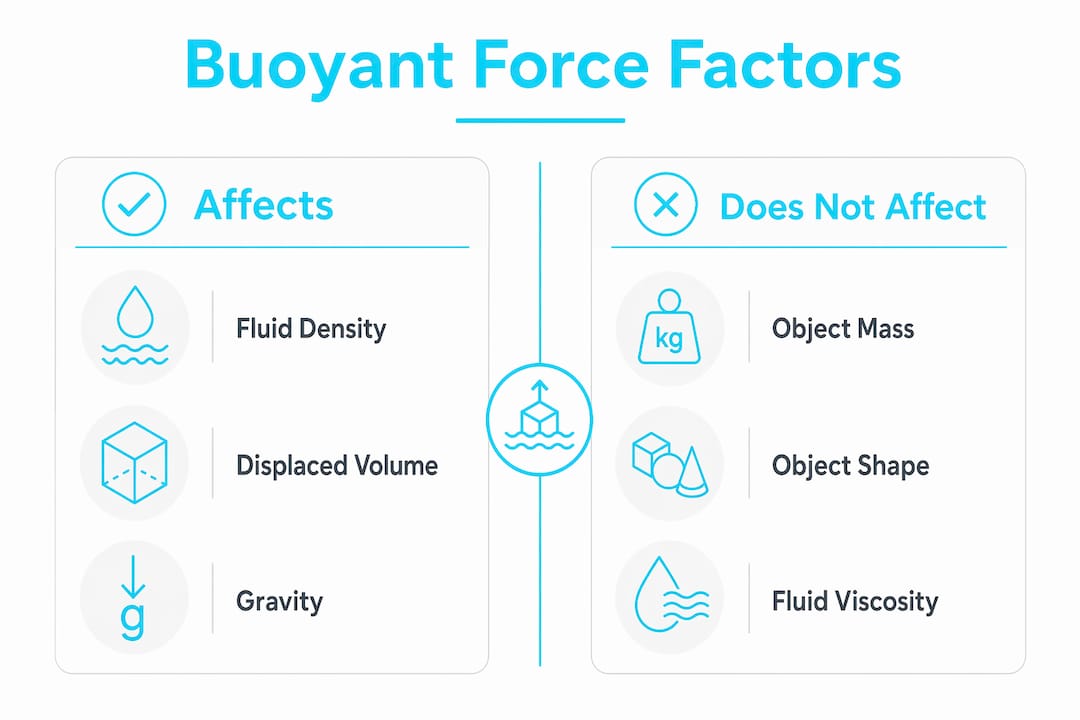
Buoyant force depends on exactly three things: the density of the fluid, the volume of fluid displaced by the object, and the local acceleration due to gravity. That’s it. The equation for buoyant force is Fb = ρ × g × V, where ρ is the fluid’s density in kg/m³, g is gravitational acceleration (9.8 m/s² on Earth’s surface), and V is the volume of fluid displaced in m³. The object’s own mass, density, or shape play no role in determining the buoyant force itself.
Here is a quick summary of what does and does not drive buoyancy:
Fluid density (ρ): Higher density fluid produces a stronger upward force.
Volume of fluid displaced (V): More displaced fluid means more buoyant force.
Gravitational acceleration (g): Stronger gravity increases the force proportionally.
Object mass: No effect on buoyant force.
Object density: No effect on buoyant force.
Object shape: No effect on buoyant force.
Submersion depth: No effect on buoyant force magnitude.
Variable | Affects buoyant force? | Why |
Fluid density (ρ) | Yes | Denser fluid weighs more per unit volume |
Displaced volume (V) | Yes | More displaced fluid means more upward force |
Gravity (g) | Yes | Scales the weight of displaced fluid |
Object mass | No | Only affects the object’s own weight |
Object shape | No | Only V of displaced fluid matters |
Submersion depth | No | Pressure increases cancel out |
How Archimedes’ principle explains buoyant force
Archimedes’ principle states that the buoyant force on an object equals the weight of the fluid it displaces. Archimedes figured this out around 250 BCE, and every naval architect and balloon engineer since has relied on it.

The reason this works comes down to pressure variation with depth. Fluid pressure increases as you go deeper. So the bottom face of any submerged object experiences higher pressure than the top face. That pressure difference produces a net upward force, which is exactly what we call the buoyant force. The deeper the bottom face relative to the top, the larger the pressure gap — but because a bigger object also displaces more fluid, the math always reduces to Fb = ρgV.
One thing students frequently mix up: buoyant force and the object’s weight are two separate force vectors. Draw them separately on a free-body diagram. Buoyant force points up; gravity points down. Whether the object floats, sinks, or hovers depends on which one is larger, not on the buoyant force alone.
Pro Tip: When drawing free-body diagrams for submerged objects, always label the buoyant force and gravitational force as distinct arrows. Treating them as one combined force is the single most common error in introductory fluid mechanics.
Factors that affect buoyant force (and what does not)
Fluid density
Saltwater is denser than freshwater, so it produces a stronger buoyant force for the same displaced volume. That small difference is why cargo ships sit noticeably higher in the ocean than in a freshwater river. Mercury, being much denser than water, produces a significantly stronger buoyant force for the same displaced volume. Fluid density is the single most powerful lever you can pull to change buoyant force.

Volume of fluid displaced
The displaced volume is not always the full volume of the object. A partially submerged object only displaces fluid equal to its submerged portion. Push a floating block deeper and the buoyant force increases because more fluid is displaced. Lift it higher and the force drops. For a fully submerged object, the displaced volume equals the object’s total volume.
Gravitational acceleration
On the Moon, where gravitational acceleration is much less than on Earth, the buoyant force on the same object in the same fluid is correspondingly smaller. This matters for spacecraft design and any engineering work done in low-gravity environments. Buoyancy force disappears entirely in true freefall or zero-gravity conditions, because the pressure gradient that creates it vanishes.
What does not affect buoyant force
Object mass, density, and shape do not influence the buoyant force. Two blocks of identical volume — one made of lead, one made of wood — experience the same buoyant force when fully submerged in the same fluid. The lead block sinks because its weight exceeds the buoyant force; the wood floats because its weight is less. The buoyant force acting on each is identical.
Fluid viscosity also has no effect on the static buoyant force. Viscosity governs how fast an object moves through a fluid, not the magnitude of the upward force. Honey and water at the same density would exert the same buoyant force on a submerged object, even though honey is far more viscous.
Factor | Effect on Fb | Notes |
Fluid density | Direct, proportional | Saltwater > freshwater |
Displaced volume | Direct, proportional | Partial submersion reduces V |
Gravity | Direct, proportional | Varies by planet or altitude |
Object mass | None | Affects weight, not Fb |
Object shape | None | Only V of displaced fluid counts |
Viscosity | None | Affects drag, not static Fb |
Submersion depth | None | Pressure effects cancel |
Key clarifications at a glance:
A steel cube and a steel sphere of equal volume feel the same buoyant force in water.
Dropping an object deeper does not change the buoyant force on it.
Switching from water to a fluid of equal density but higher viscosity leaves the buoyant force unchanged.
Comparing average densities of object and fluid predicts whether it floats or sinks.
How to calculate buoyant force: worked examples
Calculating buoyant force is straightforward once you have ρ, g, and V. The steps below walk through two common scenarios.
Identify the fluid and find its density. Water is 1,000 kg/m³; seawater is approximately 1,025 kg/m³; air at sea level is approximately 1.225 kg/m³.
Determine the displaced volume. For a fully submerged object, V equals the object’s total volume. For a floating object, V equals only the submerged portion.
Use g = 9.8 m/s² unless the problem specifies a different gravitational environment.
Apply Fb = ρ × g × V and calculate in SI units (the result is in Newtons).
Compare Fb to the object’s weight (W = mg) to predict behavior: if Fb > W, the object rises; if Fb < W, it sinks; if Fb = W, it hovers.
Example 1: Fully submerged block
A solid aluminum block is fully submerged in freshwater. Its buoyant force can be calculated using the fluid density, gravitational acceleration, and displaced volume.
Aluminum is denser than water, so the block’s weight exceeds the buoyant force and it sinks when submerged.
Example 2: Floating wooden block
A wooden block weighs 10 N and floats in freshwater. At equilibrium, Fb = 10 N. Rearranging the formula: The submerged volume of the floating wooden block can be calculated by dividing the buoyant force by the product of fluid density and gravitational acceleration; this submerged volume is less than the block’s total volume.
Pro Tip: For partial submersion problems, never plug in the object’s full volume. Measure or calculate only the submerged fraction. A common mistake is using total object volume for a floating object, which overstates the buoyant force.
Real-world applications of buoyant force
Buoyancy applies to all fluids, liquids and gases alike, which is why its applications span from ocean engineering to atmospheric science.
Ships and submarines: A steel aircraft carrier floats because its hollow hull displaces an enormous volume of water. The average density of the entire vessel, steel plus air-filled compartments, comes out below 1,000 kg/m³. Submarines control their depth by adjusting ballast tanks: flooding them with water increases average density and the sub descends; pumping water out reduces it and the sub rises.
Hot air balloons: Heated air inside the balloon envelope is less dense than the surrounding cooler air. The balloon displaces a large volume of that cooler, denser air, generating a buoyant force that exceeds the combined weight of the envelope, basket, and passengers. The pilot controls altitude by adjusting the air temperature inside the envelope.
Fluid simulation in engineering: Engineers modeling ship hulls, underwater pipelines, or buoyancy-compensated structures use CFD tools to predict how buoyant forces interact with structural loads. Platforms like Jewlztech’s CFD simulation tools let engineers test these scenarios computationally before committing to physical prototypes.
Icebergs: Ice is about 917 kg/m³ versus seawater at roughly 1,025 kg/m³. That density ratio means approximately 90% of an iceberg’s volume sits below the waterline, which is exactly what Archimedes’ principle predicts.
Hydrometry and density measurement: A hydrometer floats at different depths in fluids of different densities. The depth at which it settles directly reflects the fluid’s density, turning buoyancy into a practical measurement tool used in breweries, automotive service shops, and battery testing.
Key Takeaways
Buoyant force depends solely on fluid density, displaced volume, and gravitational acceleration, captured by Fb = ρ × g × V; the object’s own mass, density, or shape have no effect on the upward force.
Point | Details |
The governing formula | Fb = ρ × g × V; all three variables scale the buoyant force proportionally. |
Fluid density drives magnitude | Denser fluids (saltwater, mercury) produce stronger buoyant forces than less dense ones. |
Displaced volume, not object volume | A partially submerged object displaces only its submerged fraction, reducing Fb accordingly. |
Object properties are irrelevant | Mass, density, and shape affect the object’s weight, not the upward fluid force. |
Depth and viscosity do not matter | Buoyant force magnitude stays constant regardless of how deep the object sits or how viscous the fluid is. |
Recommended
Comments