
Radiation vs Convection: Simple Physics and Ground Rules
- Jewlz Technologies

- Aug 17
- 14 min read
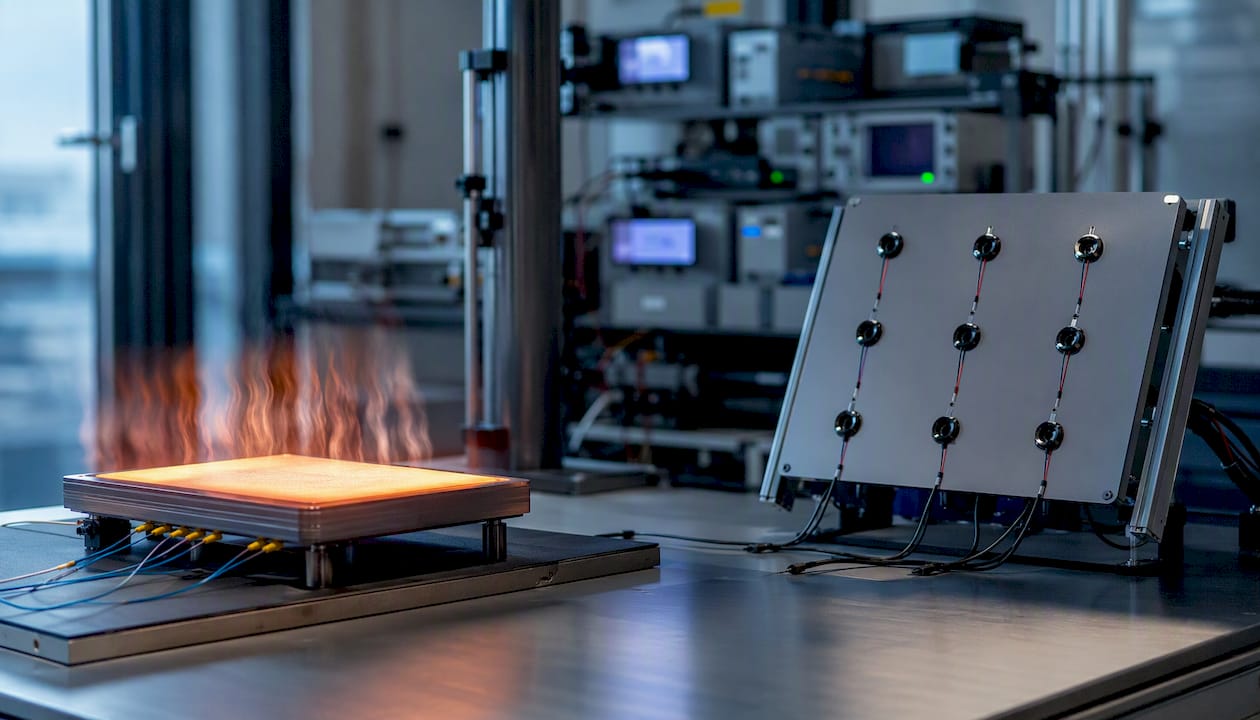
Radiation transfers heat as electromagnetic waves and needs no medium at all. Convection moves heat through the bulk motion of a fluid, air or water carrying thermal energy from one place to another. That single distinction, medium versus no medium, decides almost every homework problem you’ll face on this topic.
Here’s the quick verdict you can lean on: radiation wins at high absolute temperatures and in a vacuum, because it scales with temperature to the fourth power. Convection wins whenever a fluid can move freely at moderate temperatures, since that T^4 relationship for radiation simply can’t compete with a strong breeze or a pump pushing water through a pipe. Both mechanisms almost always operate together in real systems. You rarely get to pick just one.
Radiation = energy transfer by electromagnetic waves. Works in a vacuum. Scales with T^4.
Convection = heat carried by a moving fluid (advection) plus conduction within that fluid. Requires a medium.
Rule of thumb: high T or no fluid present, think radiation. Moderate T with air or water flowing, think convection.
Point | Details |
Mechanism differs | Radiation needs electromagnetic waves and no medium; convection needs a moving fluid. |
Temperature sensitivity | Radiation scales with absolute temperature to the fourth power, so it grows fast at high T. |
Practical decision rule | Compare an effective radiation coefficient h_rad against the convective coefficient h_conv. |
Key Takeaways
Radiation transfers energy as electromagnetic waves with no medium required, while convection moves heat through bulk fluid motion, and comparing an effective h_rad against h_conv tells you which one matters most in a given problem.
Point | Details |
Mechanism defines the mode | Radiation needs electromagnetic waves and no medium; convection needs a moving fluid to carry heat. |
Temperature drives radiation’s rise | Radiative loss scales with T^4, so it grows fast and can overtake convection at high absolute temperatures. |
Use the h_rad comparison | Convert radiation to an effective h_rad and check it against typical h_conv ranges before ignoring either mode. |
Emissivity and geometry matter | Surface finish and view factors change how much a surface actually radiates to its surroundings. |
Jewlztech supports combined-mode work | The Thermalysis Toolkit models conduction, convection, and radiation together for problems too complex for hand calculations. |
Table of Contents
Radiation vs Convection: What’s Actually Happening at the Surface
Convection is the bulk movement of a fluid carrying thermal energy with it. When warm air rises off a radiator and cooler air rushes in to replace it, that’s natural convection, driven by buoyancy differences created by temperature. When a fan or pump forces the fluid to move, that’s forced convection. Inside the moving fluid itself, heat still travels by conduction between adjacent fluid particles, so convection is really advection (bulk transport) plus a diffusion process layered on top, as standard heat transfer references) describe it.
Radiation works completely differently. Every object above absolute zero emits electromagnetic waves, mostly in the infrared range for objects near room temperature, and that emission needs no material carrier whatsoever. A campfire warms your face across several feet of open air largely through radiation, not because the air itself got hot and rose toward you. The Stefan–Boltzmann law governs how much energy a surface radiates, and that relationship depends on absolute temperature raised to the fourth power, which is why radiation intensity climbs so steeply as things get hot.
A few concrete pictures help this stick:
A fire warming your skin from across a room: radiation, mostly infrared.
A box fan cooling your face: forced convection.
A double-pane window trapping a thin layer of still air between the panes: this suppresses convection so radiation and conduction dominate the heat loss across that gap.
A metal spoon left in hot soup: conduction inside the spoon, convection at the soup surface.
Pro Tip: When you sketch a heat transfer diagram for a homework problem, draw arrows for every mode that’s physically active, not just the one the question emphasizes. Most real surfaces lose heat by convection and radiation simultaneously, and skipping one arrow is the single most common setup error students make.
The Equations You Need for Radiation and Convection
Radiative heat transfer between a surface and its surroundings follows the net Stefan–Boltzmann relation:
P_net = σ ε A (T₁⁴ − T₂⁴)
Here σ is the Stefan–Boltzmann constant (5.67 × 10⁻⁸ W/m²K⁴), ε is emissivity (a number between 0 and 1), A is surface area in square meters, and T₁ and T₂ are the absolute temperatures of the surface and its surroundings, both in kelvins. That kelvin requirement isn’t a formality. Plugging in Celsius will give you a wrong answer that looks plausible, which is exactly the kind of mistake that costs points on an exam.
Convection follows a much simpler linear form, Newton’s law of cooling/12%3A_Temperature_and_Heat/12.09%3A_Mechanisms_of_Heat_Transfer):
Q = h A ΔT
where h is the convective heat transfer coefficient (W/m²K), a number that depends on the fluid’s velocity, viscosity, and thermal properties, plus the geometry of the surface it’s flowing past. Unlike σ, h isn’t a universal constant. It has to be measured or estimated for each situation, which is why convection problems in real engineering work often lean on empirical correlations rather than a single formula.
Engineers frequently linearize radiation into a form that looks just like convection, using an effective radiation heat transfer coefficient:
q_rad ≈ h_rad A (T₁ − T₂), where h_rad ≈ 4 ε σ T_mean³
T_mean is the average of T₁ and T₂ in kelvins. This approximation is convenient specifically because it lets you add radiation directly to a convection estimate, but it only holds up when the temperature difference is modest relative to the absolute temperatures involved. A semi-empirical method published in Electronics Cooling reports about 10% accuracy for this kind of estimate across a 0°C to 130°C range, which is plenty tight for a first-pass thermal budget.
Symbol | Meaning | Units |
σ | Stefan–Boltzmann constant | W/m²K⁴ |
ε | Emissivity | dimensionless (0 to 1) |
A | Surface area | m² |
T | Absolute temperature | K |
h | Convective heat transfer coefficient | W/m²K |
h_rad | Effective radiative coefficient | W/m²K |
Always convert temperature to kelvins before plugging into the Stefan–Boltzmann law.
Remember that h_rad is an approximation, not a fixed physical constant like σ.
Radiation is inherently nonlinear; the h_rad trick only works for small to moderate ΔT.
Natural vs Forced Convection: How Fluid Motion Changes the Numbers
Natural convection happens when temperature differences alone create fluid motion. Warm fluid near a hot surface becomes less dense, rises, and pulls cooler fluid in behind it, no fan or pump required. Forced convection happens when an external device, a fan, a pump, a compressor, drives the fluid past the surface at a controlled velocity. The physics underneath both is the same advection-plus-diffusion process, but forced convection typically produces a much higher heat transfer coefficient because the fluid moves faster and sweeps away the thin boundary layer of stagnant fluid clinging to the surface more effectively.
Order-of-magnitude ranges help you sanity-check a problem. Natural convection in air commonly falls somewhere in the range of a few W/m²K with moderate values. Forced convection in air can reach substantially higher values depending on velocity. Water, being a far better conductor and having higher density than air, produces convective coefficients that can be much higher than air in comparable flow conditions. These are rough engineering ranges meant for quick estimation, not precision values you’d cite in a design report.
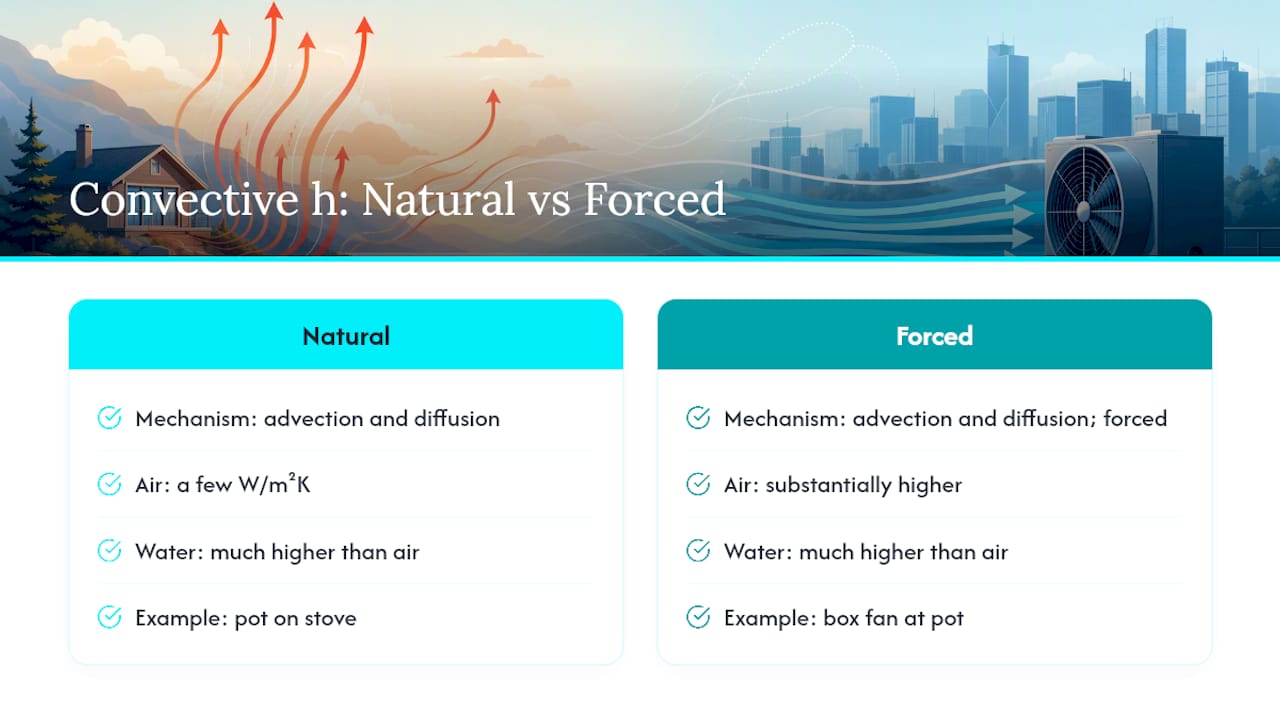
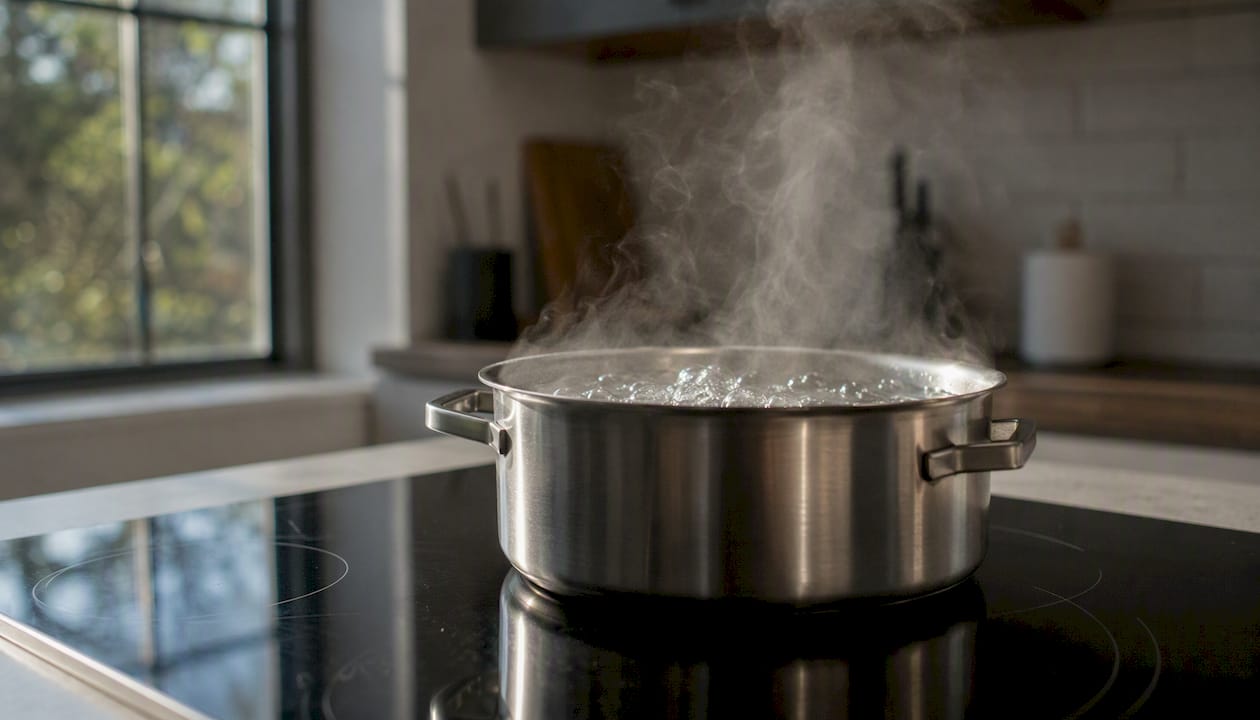
A pot of water on a stove shows natural convection clearly: the water at the bottom heats up, rises, and sets up a rolling current before it ever reaches a boil. Point a box fan at that same pot and you’ve shifted the system toward forced convection, and the cooling or heating rate changes noticeably. HVAC systems in buildings and even large-scale weather patterns run on the same underlying physics, just at wildly different scales.
Statistic Callout: Forced convection coefficients in air are typically significantly higher than natural convection in the same setting, which is a big part of why a fan feels so much more effective at cooling you down than simply standing still in warm air.
Why Emissivity and Geometry Control How Much a Surface Radiates
Emissivity measures how effectively a real surface radiates compared to a theoretical perfect emitter, a blackbody, which has an emissivity of exactly 1. A surface finished in flat carbon black might sit around 0.95, close to that ideal, while a polished metal like a tungsten filament might sit closer to 0.5 or lower depending on temperature and wavelength. Shiny, reflective surfaces radiate poorly and also reflect incoming radiation well, which is exactly why radiant heat shields are made from polished metal foil rather than dark paint.
Geometry matters just as much as surface finish, through what engineers call the view factor, a way of quantifying how much of the radiation leaving one surface actually lands on another surface rather than escaping into open space or hitting something else entirely. Two flat plates facing each other directly at close range have a view factor near 1. Tilt one of those plates, or move them far apart, and the view factor drops, meaning far less radiative exchange between them even though the temperatures haven’t changed at all.
Identify the emissivity of the radiating surface. Look it up for the specific material and finish rather than assuming a generic value.
Determine what that surface can actually “see.” A surface radiating into open sky loses heat to a very cold effective temperature, while a surface facing another warm object exchanges energy with that object instead.
Recognize that radiating area and convective area aren’t always the same number. A finned heat sink has enormous surface area for convection, since air flows around and between every fin, but neighboring fins block each other’s view of the surroundings, cutting the effective radiating area substantially.
When Does Convection Win and When Does Radiation Take Over?
Convection dominates in open-air cooling, forced-air systems, and anything submerged in a liquid, because a moving fluid can carry heat away far faster than radiation alone at moderate temperatures. A laptop cooling fan, a car radiator, a swimming pool losing heat to the surrounding water: all convection-dominated systems where the available fluid does most of the work.
Radiation takes over in vacuum, at very high temperatures, and over long distances where no fluid exists to carry heat at all. A major example is the Sun heating the Earth across empty space, and it’s also why heat transfer in vacuum relies entirely on radiative exchange for spacecraft, satellites, and thermos flasks that use a vacuum gap specifically to eliminate convective losses.
Convection dominates: open-air cooling, forced-air or liquid cooling systems, HVAC ductwork.
Radiation dominates: vacuum environments, furnace interiors, satellite radiators, Sun-to-Earth energy transfer.
Mixed cases: a campfire warms you through both radiation from the flames and convection from rising warm air; a spacecraft radiator relies purely on radiation since there’s no atmosphere to convect into.
Exceptions worth remembering: a narrow trapped air gap, like in a double-pane window, suppresses natural convection almost entirely, leaving radiation and conduction to dominate the heat flow across that gap. In dense, optically thick media like thick smoke or a furnace full of soot particles, radiative diffusion behaves almost like a conduction process rather than the simple point-to-point exchange you’d expect.
A Rule of Thumb: Compare h_rad to h_conv Before You Decide
Rather than guessing whether radiation matters, convert it into an equivalent convective coefficient and compare the two side by side. Start with h_rad ≈ 4 ε σ T_mean³, where T_mean is the average of the surface temperature and surroundings temperature in kelvins. This linearization is valid as long as the temperature difference stays reasonably small relative to the absolute temperatures, a limitation the Electronics Cooling method addresses directly by quoting its accuracy range.
Estimate T_mean in kelvins by averaging your surface temperature and the surrounding temperature.
Plug T_mean, along with the surface’s emissivity ε and the constant σ, into h_rad ≈ 4 ε σ T_mean³.
Compare that h_rad value against a typical h_conv for your situation, using rough ranges like still air, forced air, or water.
If h_rad is small relative to h_conv, radiation is probably safe to neglect for a first-pass estimate. If they’re comparable or h_rad is larger, include both.
Condition | Typical coefficient range | Radiation significance |
Free convection in air | Roughly 2 W/m²K | Radiation often comparable, should not be ignored |
Forced convection in air | Roughly 250 W/m²K | Radiation usually small relative to convection |
Convection in water | Roughly 100 to several thousand W/m²K | Radiation almost always negligible |
Radiation (near room temperature, moderate ε) | Often 4 to 8 W/m²K equivalent h_rad | Rivals free convection, dominates in still air |
Pro Tip: In outdoor radiation problems, don’t default to using the ambient air temperature as your “cold” temperature. A surface radiating upward into a clear night sky is effectively facing a much colder sky temperature than the air around it, and using the wrong reference temperature is one of the most common errors in radiative heat loss estimates for building and equipment design.
Worked Example: A Warm Metal Plate Losing Heat Two Ways
Picture a flat metal plate, 0.5 m² in area, sitting at 80°C (353 K) in a room where the air and surrounding walls sit at 20°C (293 K). The plate has an emissivity of 0.8, and we’ll assume a modest natural convection coefficient of 8 W/m²K, typical for a vertical plate cooling in still air.
Compute radiative loss using P_net = σ ε A (T₁⁴ − T₂⁴): 5.67×10⁻⁸ × 0.8 × 0.5 × (353⁴ − 293⁴). That works out to roughly 218 watts.
Compute convective loss using Q = h A ΔT: 8 × 0.5 × (80 − 20) = 240 watts.
Compare the two: radiation contributes about 218 W and convection about 240 W, meaning radiation accounts for roughly 48% of the total heat loss in this scenario, essentially neck and neck with convection.
Interpret the result: at this moderate temperature and modest convection coefficient, neither mode is safe to ignore. This is exactly the kind of case the h_rad versus h_conv comparison from the previous section is built to catch.
Raise the plate temperature well above 80°C and radiation’s T^4 dependence can take over completely, potentially exceeding convective losses even with the same convection coefficient. Drop the emissivity significantly, as you might for a polished aluminum plate, and radiation contribution decreases substantially, leaving convection to do most of the work. These two adjustments alone show how sensitive the balance is to both temperature and surface finish, which is exactly why you can’t just memorize “convection dominates” or “radiation dominates” without checking the actual numbers for your specific case.
Combining Convection and Radiation Without Double-Counting
Heat fluxes from different mechanisms simply add together at a boundary: q_total = q_conduction + q_convection + q_radiation, provided each term uses the correct reference temperatures and areas for that specific mode. That additive principle sounds obvious, but it’s where a surprising number of otherwise careful students go wrong.
The most common pitfall is applying the same “cold” reference temperature to both convection and radiation without checking whether that’s actually correct. A surface can lose heat by convection to ambient air at 20°C while simultaneously radiating to a sky effectively far colder than that, and treating both losses against the same reference number will understate total heat loss. Another frequent mistake is assuming the linear h_rad approximation holds at large temperature differences, where the real T^4 relationship diverges noticeably from a straight line, an issue technical reports on combined radiation and convection problems address in detail for coupled and high-temperature systems. Neglecting view factors entirely, treating every radiating surface as if it sees 100% of its surroundings, inflates radiative loss estimates in geometries where surfaces partially shield each other.
Statistic Callout: Skipping even one active heat transfer mode in a simulation can meaningfully shift predicted surface temperatures, which is exactly why engineering practice models radiation, convection, and conduction together rather than isolating a single dominant mechanism and calling it done.
What Practicing Engineers Check Before Trusting an Estimate
Before you decide whether radiation deserves a place in your calculation, run through a short checklist: is the system in or near a vacuum, is the absolute temperature high enough that T^4 starts to matter, is the convective coefficient unusually low (still air rather than forced flow), and does the radiating area differ meaningfully from the convective area, as it does with finned surfaces. Answering yes to any of these is a strong signal that radiation needs its own line in the calculation rather than an afterthought.
Picking parameters carefully matters more than picking a fancy method. Emissivity values should come from a materials table for the actual surface finish, not a generic guess. T_mean for the h_rad approximation should reflect the real operating temperatures of your specific problem, not room temperature by default. Convective coefficients are best pulled from established correlations for your flow geometry (a flat plate, a cylinder, a finned array) rather than reused from an unrelated example.
Hand calculations and the h_rad shortcut work well for quick first-pass estimates and homework-style problems.
Move to a dedicated thermal toolkit or CFD software once you’re dealing with combined conduction, convection, and radiation across a complex geometry, or when view factors between multiple surfaces get genuinely complicated.
Always check mesh sensitivity and boundary-layer resolution in any simulation. Under-resolving the boundary layer near a wall is a classic source of inaccurate convective predictions, as broader heat transfer references note.
A tool like Jewlztech’s Thermalysis Toolkit can help students move from hand-calc estimates to a fuller multi-mode simulation once the problem outgrows a napkin sketch.
Pro Tip: If you’re just starting to build intuition, work through the same problem twice, once by hand with the h_rad approximation and once in a more detailed tool. Seeing where the two answers diverge teaches you far more about when linearization breaks down than any textbook paragraph will.
Why the h_rad Shortcut Deserves More Respect Than It Gets
Most physics courses treat radiation and convection as separate chapters, each with its own formula, and that framing quietly teaches students to think of them as competing rather than cooperating. The reality of almost every thermal problem you’ll encounter after the classroom is that both mechanisms run at once, and the skill that actually separates a strong estimate from a sloppy one is knowing how to compare their magnitudes quickly, not memorizing which one “wins” in the abstract.
The h_rad approximation gets dismissed sometimes as a hack, a simplification that real engineers supposedly abandon for full simulation. That’s backward. The shortcut exists precisely because full radiative simulation is expensive to set up and often unnecessary, and knowing when a linear estimate is good enough is a more valuable skill than knowing how to run a Monte Carlo radiative solver you’ll rarely need. Spend your practice time on two or three worked problems where you vary temperature and emissivity and watch how the balance between h_rad and h_conv shifts. That single exercise, repeated a few times with different numbers, teaches the physics better than reading ten pages of derivation ever will.
An Optional Next Step for Combined-Mode Problems
Hand calculations and the h_rad shortcut cover a huge share of real problems, and this article works fine as a standalone reference for that. Where it starts to strain is conjugate problems, cases where conduction inside a solid, convection at its surface, and radiation to its surroundings all interact and none of them can be solved in isolation, or geometries with several surfaces radiating to each other where view factors get genuinely messy to estimate by hand.
The Thermalysis Toolkit from Jewlztech handles exactly that kind of combined-mode problem, with conduction, convection, and radiation modeled together, a built-in material property database so you’re not hunting for emissivity values in five different tables, and support across a wide temperature range. It ships as a downloadable Excel-based tool, which means you can check your hand calculations against it directly without learning a whole new interface. If a finned heat sink or a multi-surface enclosure problem is eating up more time than it should, that’s the moment to check the toolkit out and see whether it fits your workflow.
Where to Read Deeper on Radiation and Convection
Georgia State University’s Physics LibreTexts chapter on mechanisms of heat transfer gives a clean textbook walk-through of conduction, convection, and radiation with worked examples suited to an introductory physics course.
The Stefan–Boltzmann law notes from JILA cover the derivation and astrophysical context behind the T^4 relationship, useful if you want to see where the constant σ actually comes from.
For a hands-on engineering method, the Electronics Cooling article on estimating radiation heat transfer walks through the h_rad linearization with accuracy figures and worked numbers geared toward real design problems.
The Wikipedia entry on convection is a solid jumping-off point for natural versus forced convection distinctions and links out to more advanced fluid dynamics topics.
A NASA technical report on radiation combined with conduction and convection covers advanced solution methods, including exchange factor approaches and the diffusion approximation, for anyone heading toward coupled or participating-media problems in a later course.
A technical note on heat transfer in vacuum explains why radiation becomes the sole heat transfer mode once convection is eliminated, directly relevant to spacecraft and vacuum flask design.
Sources
Recommended
Comments