
Compute Prandtl Number in 4 Steps, Example & Toolkit for Engineers


The Prandtl number (Pr) equals the ratio of momentum diffusivity to thermal diffusivity, written as Pr = ν/α or Pr = μ cp / k. It tells you whether heat or momentum spreads faster through a fluid, which in turn tells you whether the thermal boundary layer will be thinner or thicker than the velocity boundary layer at a wall. That single ratio drives correlation choices in nearly every convection problem you’ll touch.
TL;DR:
The Prandtl number is an intensive property that compares a fluid’s momentum diffusivity to thermal diffusivity at a specific temperature and pressure.
Fluids with Pr less than 1, like mercury, have thermal diffusion dominating, while those with Pr greater than 1, such as oils, see momentum diffusion lead.
Typical Pr values range from about 0.015 for liquid metals to over 10 for viscous oils, with water’s Pr varying significantly from 7 at room temperature to lower at higher temperatures.
Pr influences boundary-layer thickness ratios and heat transfer correlations, often appearing alongside Reynolds number in Nusselt number formulas.
Accurate Pr calculation requires using actual operating temperature properties; tools and property tables help avoid common errors and support scaling and sizing decisions.
Table of Contents
What Is the Prandtl Number? Definition and Formula
Pr shows up in two equivalent forms, and knowing both saves you a lookup step depending on which properties you have on hand:
Pr = ν/α — the ratio of kinematic viscosity (momentum diffusivity) to thermal diffusivity, both measured in m²/s
Pr = μ cp / k — the same ratio built from dynamic viscosity μ (Pa·s), specific heat cp (J/kg·K), and thermal conductivity k (W/m·K)
Both forms come from the same physics, and Wikipedia’s entry on the Prandtl number lays out the derivation cleanly if you want the full dimensional analysis. Because Pr is built entirely from thermophysical properties, it’s an intensive quantity. It depends on the fluid’s temperature and pressure, not on pipe diameter, plate length, or flow velocity. That distinction matters the moment you start comparing it to Reynolds number, which we’ll get to shortly. For now, the practical point is this: if you know a fluid’s state (say, water at 40°C), you can pull Pr straight from a property table without knowing anything about the geometry it’s flowing through.
What Does the Prandtl Number Physically Mean?
Pr is really a race between two diffusion processes. When Pr is less than 1, thermal diffusion wins. Heat spreads through the fluid faster than momentum does, which is exactly what happens in liquid metals like mercury or liquid sodium. When Pr is greater than 1, momentum diffusion wins, and that’s the story for oils, glycerin, and other viscous liquids where velocity changes propagate through the fluid faster than temperature changes do.
This ratio governs how the thermal boundary layer compares to the velocity boundary layer on a surface. For laminar flow over a flat plate, a common approximation is δ_t / δ ≈ Pr^(−1/3), valid roughly over 0.6 ≤ Pr ≤ 50, as Wikipedia notes. A high Pr fluid has a thermal boundary layer much thinner than its velocity boundary layer. A low Pr fluid has the opposite: heat has already diffused well beyond where the velocity profile has caught up.
Pr < 1: thermal boundary layer is thicker than the velocity boundary layer
Pr > 1: thermal boundary layer is thinner, nested inside the velocity boundary layer
Pr ≈ 1: the two boundary layers grow at roughly the same rate
Reynolds number tells you whether flow is laminar or turbulent, and it changes with velocity and length scale. Pr never does that. It’s a fixed fluid property at a given temperature, which is exactly why the Encyclopedia of Dimensionless Numbers treats it as an intensive characteristic independent of length scale.
Pro Tip: Look up Pr before you touch a correlation. If you already know your fluid’s Pr range, you can immediately guess whether the thermal boundary layer will be the limiting factor in your heat-transfer design or an afterthought.
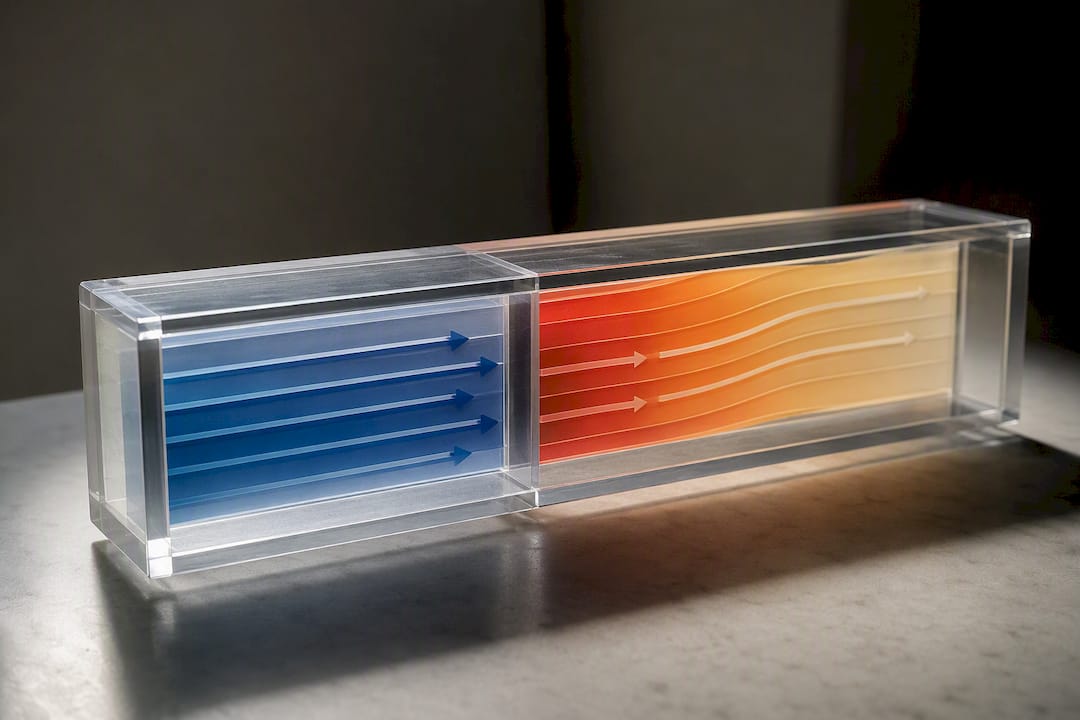
Typical Prandtl Number Values for Common Fluids
Property tables sort neatly into three regimes, and memorizing the rough bands saves you constant lookups during early design work.
Liquid metals (Pr ≈ 0 to 0.1): mercury sits around 0.015, and liquid sodium is even lower. Thermal diffusion dominates so strongly that conduction, not convection details, drives the heat-transfer behavior.
Gases: air at 20°C runs close to Pr ≈ 0.7, and most common gases cluster in a similar band because momentum and thermal diffusion happen through the same molecular collisions.
Oils and viscous liquids (Pr > 10): engine oils and glycerin can reach into the hundreds or thousands, since high viscosity slows momentum diffusion far less than it slows heat conduction.
Water is the outlier worth flagging separately. At room temperature, water’s Prandtl number is relatively high, but it drops as temperature rises because viscosity decreases sharply while thermal conductivity changes little. This is the regime breakdown documented across sources that most heat-transfer textbooks repeat, and it’s worth internalizing: for liquids generally, don’t assume a single Pr value covers your whole operating range. For gases, you usually can.
How Prandtl Number Drives Nusselt Number Correlations
Pr rarely stands alone in engineering calculations. It almost always shows up paired with Reynolds number inside a Nusselt number correlation, because Nu is what actually gives you the convective heat-transfer coefficient you need for sizing equipment.
The general form looks like Nu = C Re^m Pr^n, where C, m, and n depend on flow geometry and regime. ScienceDirect’s overview of the Prandtl number confirms this coupling is standard across internal-flow and external-flow correlations, including Dittus-Boelter style equations for pipe flow. The exponent on Pr is usually smaller than the exponent on Re, but it’s rarely negligible. A fluid with Pr = 100 and a fluid with Pr = 1 at the same Reynolds number will produce noticeably different Nusselt numbers, and that difference translates directly into different convective heat-transfer coefficients.
Pr also connects to Péclet number through Pr = Pe / Re, where Pe measures the ratio of advective to diffusive heat transport. Engineers lean on this relationship when scaling lab-scale experiments up to full-size equipment. If two systems share the same Pr and match on Re or Pe, similarity models let you translate test results without rebuilding the whole setup at full scale.
Nu = f(Re, Pr) is the backbone of most forced-convection correlations
Higher Pr generally increases Nu at fixed Re, but the exact exponent depends on the correlation
Pr = Pe / Re links diffusive and advective transport for similarity scaling
If you’re sizing a pipe-flow heat exchanger, our guide on forced convection in pipes walks through applying these correlations with real numbers.
Worked Example: Calculating Prandtl Number for Water at 50°C
Here’s the full calculation, done the way you’d actually do it with a property table in front of you.
Pick the fluid and state: water at 50°C, standard atmospheric pressure.
Pull the properties: dynamic viscosity μ ≈ 5.47 × 10⁻⁴ Pa·s, specific heat cp ≈ 4181 J/kg·K, thermal conductivity k ≈ 0.644 W/m·K.
Apply Pr = μ cp / k: Pr = (5.47 × 10⁻⁴ Pa·s × 4181 J/kg·K) / 0.644 W/m·K.
Work the arithmetic: numerator = 2.287 J/(m·s), divided by 0.644 W/m·K gives a Prandtl number consistent with liquid fluids at this temperature.
Property | Symbol | Value | Unit |
Dynamic viscosity | μ | 5.47 × 10⁻⁴ | Pa·s |
Specific heat | cp | 4181 | J/kg·K |
Thermal conductivity | k | 0.644 | W/m·K |
Calculated Prandtl number | Pr | ≈3.55 | dimensionless |
A Pr of 3.55 places water at 50°C solidly between air and viscous oils. Momentum diffuses a bit faster than heat, so the thermal boundary layer runs slightly thinner than the velocity boundary layer, but the two stay in the same ballpark. Compare that to the room-temperature value near 7, and you can see how much a 30 degree swing changes the number. That sensitivity is exactly why liquid property tables matter more than gas tables when precision counts.
How Engineers Apply the Prandtl Number in Practice
Pr shows up wherever convective heat transfer needs quantifying, and it touches decisions well before you run a single simulation.
Correlation selection: Pr tells you which Nusselt correlation applies and whether you need liquid-metal-specific treatments or standard forced-convection equations.
Heat exchanger sizing: designers use Pr alongside Re to estimate convective coefficients on both hot and cold sides, directly shaping tube length and surface area choices. Our heat exchanger examples guide shows this in practice.
CFD meshing: near-wall mesh resolution depends partly on expected thermal boundary layer thickness, which Pr predicts before you even build the mesh.
Fluid selection: a high Pr fluid resists rapid heat spreading despite conducting momentum well, which matters when choosing coolants or heat-transfer fluids for a given application.
Test scaling: matching Pr and Re between a scaled test rig and full-size equipment keeps similarity valid, saving costly full-scale prototyping.
Practical Tips and Common Pitfalls When Working With Pr
A few habits separate a clean Pr calculation from a wrong one that quietly propagates through a whole design.
Pull liquid properties at the actual operating temperature, not at a convenient reference point. Liquid Pr can shift by a factor of two or three across a modest temperature range.
Check units before you multiply. Mixing μ in centipoise with k in W/m·K without converting is the single most common arithmetic error in this calculation.
For gases, Pr ≈ 0.7 is a safe shortcut across a wide temperature band, so you rarely need to recalculate unless you’re near extreme conditions.
For liquids with high Pr variance, practitioners rely on property tables at actual operating temperatures rather than constant approximations, especially in heat-exchanger sizing.
Pro Tip: *When you’re unsure whether a liquid’s Pr has shifted enough to matter, recalculate at both your inlet and outlet temperatures.
Applying Pr Inside a Thermal Simulation Workflow
A property database paired with a calculation template turns Pr from a manual lookup into a repeatable input. Toolkit resources, including the Nusselt number worked example, walk through pulling fluid properties, computing Pr, and feeding it directly into Nu correlations for convective coefficient estimates used in real design work.

When the Prandtl Number Tells You Enough, and When It Doesn’t
Pr is genuinely useful for quick judgment calls. If you know a fluid’s Pr range, you can predict boundary-layer behavior and pick a starting correlation without running a single simulation. That’s real design leverage for single-phase, steady flows.
Where it breaks down is multi-phase flow, non-Newtonian fluids, and anything with strong property variation across the domain. At that point, a single Pr value stops representing the fluid, and you need full CFD or physical testing to capture what’s actually happening.
— Joel
Skip the Property Tables With the Jewlz Engineering Toolkit
An advantage over hunting through property tables and rebuilding spreadsheets every project is simple: one toolkit with a built-in property database handles conduction, convection, and radiation calculations in the same place, so you’re not juggling three different sources to get a Pr value and a Nusselt correlation to agree.

The Jewlz Engineering Toolkit covers Pr-based heat-transfer calculations alongside CFD and pressure vessel simulation, all built around variable material properties across a wide temperature range. If you’re sizing a heat exchanger and want the correlation work done inside a structured template rather than a blank spreadsheet, the engineering toolkit landing page lays out what’s included, from thermal analysis to fluid flow simulation. Basic tools are free to try, and the subscription unlocks the full toolkit for engineers running these calculations regularly. Start with a free tool, see how the property database handles your fluid, and upgrade when you need the advanced modules.
Sources
FAQ
What does the Nusselt number tell us?
Nusselt number measures the ratio of convective to conductive heat transfer across a fluid boundary, and it’s calculated as a function of both Reynolds and Prandtl numbers. A higher Nu means convection is moving heat far more effectively than conduction alone would.
What are the applications of the Prandtl number?
Engineers use Pr to select heat-transfer correlations, size heat exchangers, guide CFD mesh resolution near walls, and choose fluids for thermal systems where boundary-layer behavior matters. It also supports similarity scaling when translating lab-scale tests to full-size equipment.
What is the Prandtl number for water?
Water’s Pr is around 7 at room temperature and drops as temperature rises toward 100°C, since viscosity falls faster than thermal conductivity changes. The exact value depends heavily on the operating temperature, so pulling from a property table at your actual conditions beats using a single fixed number.
How do I calculate the Prandtl number for a specific fluid?
Use Pr = μ cp / k with property values at your fluid’s actual operating temperature, or Pr = ν/α if you already have kinematic viscosity and thermal diffusivity. Toolkits with built-in property databases, including Jewlztech’s engineering toolkit, can pull these values automatically and run the calculation for you.
Recommended
Comments