
Heat and Temperature Relationship: A Student's Guide


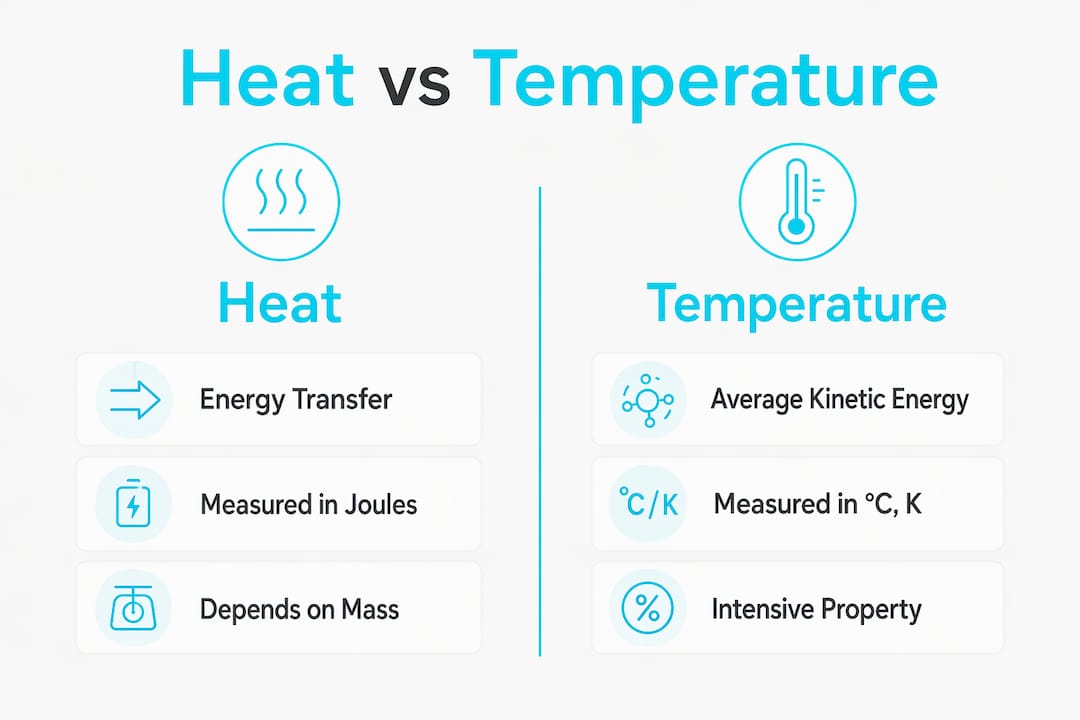
Heat is the transfer of energy caused by a temperature difference, while temperature measures the average kinetic energy of particles in a substance. These two concepts are related but not the same, and confusing them leads to real errors in physics, chemistry, and engineering. Temperature is measured in degrees Celsius, Fahrenheit, or Kelvin. Heat is measured in joules or calories. Understanding what is the relationship between heat and temperature means recognizing that one describes a system’s state and the other describes energy in motion between systems.
What is the relationship between heat and temperature?
Temperature and heat are connected by a single physical rule: heat flows from a region of higher temperature to a region of lower temperature. That flow continues until both regions reach the same temperature, a condition called thermal equilibrium. At equilibrium, no net heat transfer occurs.

The distinction matters because temperature is a property of a system. Heat is not. Heat only exists while energy crosses a boundary. Once the transfer stops, there is no “heat” left inside the object. What remains is internal energy, which temperature reflects. This is why physicists treat heat as a process, not a possession.
Think of it this way: temperature is like the pressure reading on a tire gauge. It tells you the state of the system right now. Heat is like the air you pump in. It only exists during the act of transfer. Once you stop pumping, the air becomes part of the tire’s internal state.
What is temperature and how is it measured?
Temperature is defined as the average kinetic energy of the particles in a substance. The faster the particles move, the higher the temperature. This definition comes from kinetic molecular theory and applies to solids, liquids, and gases alike.
Temperature is an intensive property. That means it does not depend on how much material you have. A cup of boiling water and a pot of boiling water are both at 100°C. The pot holds more thermal energy, but the temperature is identical. This is a critical point that students often miss.
Three major scales measure temperature:
Celsius (°C): Based on the freezing and boiling points of water at sea level. Used in most scientific work and everyday life outside the United States.
Fahrenheit (°F): The standard scale in the United States for everyday use. Water freezes at 32°F and boils at 212°F.
Kelvin (K): The absolute scale used in physics and engineering. Absolute zero (0 K) represents the point where particles have no kinetic energy and no motion. Kelvin has no negative values, making it the preferred scale for thermodynamic calculations.
Pro Tip: When working with the formula q = mcΔT, always convert temperature differences to Kelvin or Celsius. A change of 1°C equals a change of 1 K, so either works for ΔT. Never use Fahrenheit in this formula without converting first.
The Rankine scale is the absolute equivalent of Fahrenheit, used in some American engineering contexts. For most scientific work, Kelvin is the standard.
What is heat and how does it differ from temperature?
Heat is energy in transit. Specifically, it is energy transferred between two systems because of a temperature difference. Heat is not stored inside an object. Once the transfer ends, the energy becomes part of the object’s internal energy, not “heat” anymore.
This is where the difference between heat and temperature becomes sharp. Temperature describes a state. Heat describes a process. You can measure the temperature of a rock sitting on a table. You cannot measure the heat of that same rock unless it is actively transferring energy to or from something else.
Heat is also an extensive property, which means it depends on the amount of material involved. More mass means more total energy transferred, even at the same temperature. A small mass at high temperature may transfer less total heat than a large mass at a lower temperature. This is counterintuitive but physically accurate.
Common misconceptions about heat vs temperature concepts:
“Hot objects contain heat.” Objects contain internal energy, not heat. Heat only exists during transfer.
“Higher temperature always means more heat transferred.” Mass and specific heat capacity also determine total heat transfer.
“Heat and thermal energy are the same thing.” Thermal energy is stored in a system. Heat is the transfer of that energy.
“Temperature tells you how much energy an object has.” Temperature tells you the average energy per particle, not the total energy.
Pro Tip: When a student says “the metal has a lot of heat,” redirect to “the metal has a high temperature” or “the metal transferred a large amount of heat.” Precise language builds precise thinking.
Heat is measured in joules (J) in the SI system. Calories are also used, particularly in chemistry and nutrition contexts. One calorie equals 4.184 joules.
How does heat transfer affect temperature change?
The quantitative link between heat and temperature change is expressed by the formula q = mcΔT. Here, q is the heat transferred in joules, m is the mass in grams or kilograms, c is the specific heat capacity/07%3A_Energy_and_Chemical_Processes/7.02%3A_Heat_and_Temperature) of the material, and ΔT is the change in temperature.
This formula shows that two materials can absorb the same amount of heat and experience very different temperature changes. The specific heat capacity of water is much higher than that of most metals. Water resists temperature change. Metals respond quickly.
The steps for applying q = mcΔT in practice:
Identify the substance. Look up or recall its specific heat capacity ©.
Measure or estimate the mass (m). Use consistent units throughout.
Determine the temperature change (ΔT). Subtract initial temperature from final temperature.
Calculate heat (q). Multiply m × c × ΔT.
Check units. Heat should be in joules if mass is in grams and c is in J/(g·°C).
The table below shows how specific heat capacity affects temperature change when 1,000 joules of heat are added to 100 grams of different materials:
Material | Specific heat (J/g·°C) | Temperature change (°C) |
Water | 4.18 | 2.39 |
Aluminum | 0.897 | 11.15 |
Iron | 0.449 | 22.27 |
Copper | 0.385 | 25.97 |
Water’s high specific heat explains why coastal climates are milder than inland ones. The ocean absorbs enormous amounts of heat with minimal temperature change. Iron and copper respond to the same heat input with temperature changes more than ten times larger.
One important exception: heat transfer does not always cause a temperature change. During a phase change, such as melting ice or boiling water, added heat changes the state of the substance without raising its temperature. This heat is called latent heat, and it is why a pot of water stays at 100°C while it boils, even as heat continues to flow in.
How do heat and temperature apply in real-world contexts?
The difference between heat and temperature shows up constantly in everyday life, though most people do not notice it. A welding spark reaches temperatures above 1,600°C. A full bathtub sits at around 40°C. Yet the bathtub transfers far more heat to your skin than the spark does. The spark has a tiny mass. The bathtub has an enormous one. Total heat transferred depends on both temperature and mass, not temperature alone.
This principle has direct consequences in engineering and environmental science. Industrial processes that release large volumes of warm water into rivers raise the water temperature significantly, even though the water is not extremely hot. Heat waste from industry flows into the atmosphere and oceans, driving environmental temperature changes over time.
Heat transfer occurs through three mechanisms, each driven by temperature differences:
Conduction: Energy moves through direct contact between particles, primarily in solids. A metal spoon in hot soup conducts heat to your hand.
Convection: Energy moves through fluid motion, in liquids and gases. Hot air rises and cool air sinks, creating circulation patterns.
Radiation: Energy moves as electromagnetic waves without requiring a medium. The sun heats Earth through radiation across the vacuum of space.
Understanding these heat transfer mechanisms is the foundation of thermal management in engineering. Every cooling system, heat exchanger, and thermal insulator is designed around controlling one or more of these three processes. For a deeper look at how these principles apply in practice, the heat exchange examples guide from Jewlztech covers real engineering scenarios in detail.
Thermal equilibrium is the end state of every heat transfer process. Two objects in contact will always move toward the same temperature. This principle governs everything from refrigerator design to the way your body regulates core temperature in cold weather.
Key Takeaways
Temperature measures the average kinetic energy of particles in a system, while heat is the energy transferred between systems due to a temperature difference, and the two are linked by the formula q = mcΔT.
Point | Details |
Temperature is intensive | Temperature does not change with the amount of material; a cup and a pot of boiling water share the same temperature. |
Heat is a process, not a property | Heat only exists during energy transfer; once transfer stops, the energy becomes internal energy. |
q = mcΔT links both concepts | Heat transferred depends on mass, specific heat capacity, and temperature change, not temperature alone. |
High temperature does not mean high heat | A spark is hotter than a bathtub but transfers far less heat due to its tiny mass. |
Phase changes are an exception | During melting or boiling, heat input does not raise temperature; it changes the state of the substance instead. |
Why students keep getting this wrong (and how to fix it)
The confusion between heat and temperature is not a failure of intelligence. It is a failure of language. Everyday speech uses “heat” and “temperature” interchangeably. “Turn up the heat.” “It’s so hot outside.” These phrases train the brain to treat the two as synonyms before a student ever opens a physics textbook.
The fix is not memorizing definitions. The fix is building a mental model around the intensive versus extensive property distinction. Temperature is a per-particle measurement. Heat is a total-system measurement of energy in motion. Once that framing clicks, the spark-versus-bathtub example stops being confusing and starts being obvious.
I have seen students ace the q = mcΔT calculation and still write on an exam that “the iron rod contains more heat than the water because its temperature is higher.” They learned the formula without learning the concept. The formula is a tool. The concept is the foundation.
The environmental science connection also tends to surprise students. Climate and heat transfer are inseparable. The ocean’s enormous mass means it absorbs vast amounts of heat with small temperature increases. That stored energy then drives weather systems, currents, and long-term climate patterns. Temperature alone does not tell that story. Total heat does.
My advice: practice translating between everyday language and precise scientific language. When you hear “the metal is hot,” ask yourself: hot relative to what? How much mass? How much heat would it actually transfer? That habit of questioning is what separates a student who understands thermodynamics from one who just passes the test.
— Joel
Thermal analysis tools from Jewlztech
Understanding the relationship of heat to temperature is the first step. Applying it in real systems is where engineering begins. Jewlztech builds free thermal simulation tools designed for exactly that transition, from classroom concept to working design.

The Thermalysis Toolkit from Jewlztech lets engineers and advanced students model heat transfer, visualize temperature distributions, and run CFD simulations without a paid license. Whether you are analyzing conduction through a pressure vessel wall or mapping convection in a cooling system, the toolkit applies q = mcΔT and full thermal physics at the simulation level. If you are ready to move from theory to practice, the Thermalysis Toolkit is the place to start.
FAQ
What is the difference between heat and temperature?
Temperature is the average kinetic energy of particles in a substance, measured in Celsius, Fahrenheit, or Kelvin. Heat is the energy transferred between substances due to a temperature difference, measured in joules or calories.
Does more heat always mean higher temperature?
No. Heat transferred depends on mass and specific heat capacity, not just temperature. A large mass at low temperature can transfer more heat than a small mass at high temperature.
What is thermal equilibrium?
Thermal equilibrium is the state where two systems reach the same temperature and no net heat flows between them. All heat transfer processes move toward this end state.
Why does water heat up more slowly than metal?
Water has a much higher specific heat capacity than most metals. The formula q = mcΔT shows that a higher c value means more heat is required to produce the same temperature change in the same mass of material.
Can heat transfer occur without a temperature change?
Yes. During phase changes such as melting or boiling, heat flows into a substance without raising its temperature. This energy goes into breaking intermolecular bonds rather than increasing particle speed.
Recommended
Comments