
What Does CFD Software Actually Cost in 2026?
- Jewlz Technologies

- 4 days ago
- 10 min read

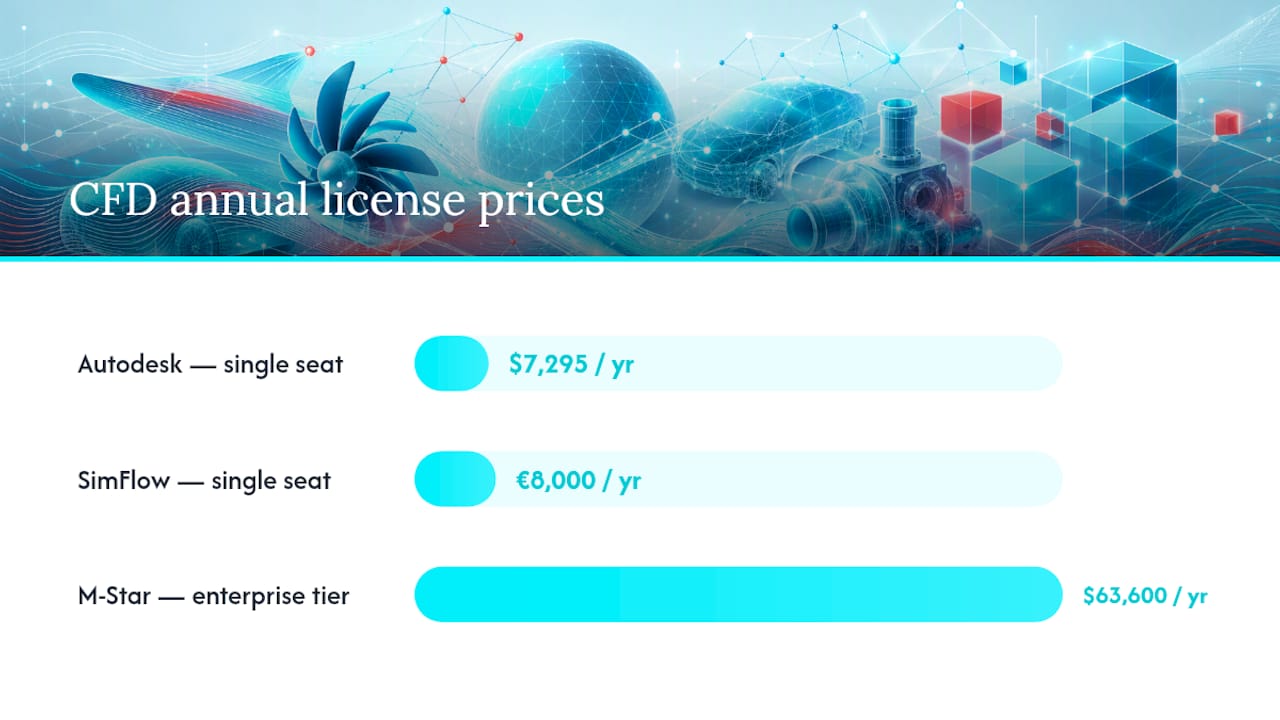
Expect commercial single-seat CFD subscriptions to run roughly $7,000 to $15,000 per year, with enterprise floating-license pools climbing well into six figures once concurrency and multi-physics modules get added. Autodesk CFD lists node-locked subscriptions starting near $7,295 per year, and that number is a reasonable floor for a single professional seat, not a ceiling.
The sticker price is rarely the real price. Compute, support contracts, and staff training routinely add 30 to 50 percent on top of whatever the license quote says, and most buyers only discover this after signing.
Open-source solvers like OpenFOAM eliminate the license line entirely. They do not eliminate cost. Running OpenFOAM well requires engineering time, Linux fluency, and often a paid support arrangement, which we’ll break down below.
Single-seat commercial subscriptions: starting from several thousand dollars per year
Enterprise/floating license pools: often running into tens or hundreds of thousands annually depending on module count and concurrency
OpenFOAM: $0 license cost, but real operational and staffing expense
Pro Tip: Before comparing two vendor quotes, ask each one for a “fully loaded” annual number that includes support, mandatory modules, and any cloud compute allowance. Bare license prices are almost never comparable across vendors.
Key Takeaways
Commercial CFD software typically costs $7,000 to $15,000 per seat annually, enterprise pools cost substantially more, and open-source options like OpenFOAM trade license fees for operational and staffing costs.
Point | Details |
Single-seat pricing baseline | Budget $7,000 to $15,000 per year for a commercial node-locked license as a starting benchmark. |
Enterprise costs scale with concurrency | Floating pools with multiple modules can push enterprise pricing well past $50,000 annually. |
OpenFOAM isn’t free in practice | Zero license cost still requires engineering time, Linux expertise, and possibly a paid maintenance plan. |
License fees are a minority cost | Staffing, training, compute, and support often outweigh the license line over three to five years. |
Match the tool to the workflow | Jewlztech’s Thermalysis Toolkit offers a subscription model specialized for thermal and CFD workflows without enterprise-scale commitments. |
Table of Contents
How Much Does CFD Software Cost for a Single Seat vs. an Enterprise Team?
A single-user, node-locked commercial license is where most engineers start pricing, and the published numbers cluster more tightly than the industry’s reputation for opacity would suggest. Autodesk’s CFD product lists subscription pricing starting around $7,295 per year for a single-user node-locked license. Smaller specialty vendors publish comparable figures. SimFlow, for instance, lists a professional single-seat license around €8,000 per year, with its enterprise floating license running near €10,000 annually on the same pricing page. Those euro figures won’t convert cleanly to a U.S. budget line, but they show the general band commercial vendors are competing in.
Practitioner forums tell a similar story from the buyer’s side. Long-running discussions on CFD-Online about real-world software costs consistently place single-seat commercial packages for tools like ANSYS Fluent or STAR-CCM+ in the low five-figure range annually, with the exact number swinging based on which physics modules and mesh sizes you need turned on.
Enterprise and floating licenses are a different animal entirely. Instead of paying per named user, you’re buying a pool of concurrent seats that multiple engineers draw from during peak load. That flexibility costs money. Some vendors price high-end enterprise tiers well beyond the single-seat band. M-Star Simulations publishes an annual per-license figure around $63,600 for one of its tiers, which illustrates how quickly “enterprise” pricing can outpace what a single engineer would ever pay individually.
Three things drive that enterprise premium up:
Concurrency: more simultaneous users drawing from the license pool
Module stacking: turbulence models, multiphase flow, combustion, and fluid-structure interaction each typically cost extra
Multi-physics bundling: combining CFD with structural or electromagnetic solvers under one contract
Cloud and usage-based pricing adds a third pricing dimension on top of seats and modules. Instead of paying for a fixed license, you pay per solve, per core-hour, or per burst of cloud compute you spin up during a deadline crunch. This model can be cheaper for teams with spiky, unpredictable workloads, but it also hides costs that don’t show up until the invoice arrives. Network egress, storage for large mesh files, and idle instance time all get billed separately from the “solver” line item.
When you’re collecting quotes, ask every vendor the same question: what is the fully loaded annual cost, including any required cloud credits, mandatory support tier, and the modules you’ll actually need for your physics? A quote that excludes those is not a real number. It’s a marketing anchor.
Node-Locked, Floating, or Cloud: Which License Model Fits Your Team?
CFD vendors sell access to their solvers through a handful of recurring structures, and confusing them is the single fastest way to compare two quotes that aren’t actually comparable.
Node-locked license. Tied to one machine or one named user. Cheapest per seat, but useless if that engineer is out or the workload shifts to someone else.
Floating (network) license. Sits on a license server and gets checked out by whoever needs it, up to the pool’s concurrency limit. Costs more per license than node-locked, but a pool of ten floating seats can often support fifteen or twenty engineers if their peak usage doesn’t overlap.
Per-core or per-node pricing. Charges scale with the hardware you run on rather than the number of users. This becomes cost-effective once your simulations are large enough that you’re running fewer, bigger jobs rather than many small ones.
Per-solver pricing. You pay separately for each physics module (turbulence, radiation, combustion) rather than one bundled package, which suits teams that only need one or two capabilities.
Cloud subscription. Usage-based, billed by compute time or by solve, with no fixed seat count at all.
The economics flip depending on how peaked your usage is. A team that runs simulations constantly, all day, every engineer, benefits from node-locked seats because there’s no idle capacity to share. A team where three engineers occasionally need CFD access, but never all at once, does much better with a small floating pool. Per-core pricing tends to win only once your average job size exceeds what a handful of workstations can chew through in a reasonable time.
The practical move: ask each vendor for their effective cost per peak-hour or per-solve, not just the sticker license price. That single number lets you stack a node-locked quote against a floating quote against a cloud quote on equal footing.
Where CFD Costs Hide Beyond the License Line
License fees are the cost everyone budgets for. They’re rarely the cost that breaks the budget. Insight from industry buyer guides notes that licensing fees are often a minority of the three- to five-year cost of running a serious simulation workload, once you count everything else.
Compute is the first hidden line. An on-prem cluster means capital expense up front (servers, cooling, networking) plus ongoing operations cost for power and IT staff time. Cloud compute swaps that for pure OPEX: instances, storage, and network egress billed monthly, which is easier to budget month to month but harder to cap if a project runs long.
Staffing costs even harder to see coming. A senior CFD engineer’s time costs multiples of a junior engineer’s, and every new tool introduces a ramp-up period where junior staff produce less useful output while they learn meshing strategy, boundary condition setup, and solver tuning. That ramp-up is a real dollar cost, not a footnote.
Annual maintenance and support: often a fixed percentage of license price for perpetual licenses, frequently bundled into subscription pricing
Training: internal onboarding time plus any formal courses, which can run substantial hours per new hire
Data management: storage for mesh files and result sets grows fast on transient or multiphase runs
Pre/post-processing tools and third-party integrations: often licensed and budgeted separately from the solver itself
Pro Tip: Track your senior-to-junior engineer time ratio on your first few projects with any new solver. If junior staff are spending more than half their time troubleshooting setup rather than running physics, your real training cost is higher than whatever line item you budgeted.
Support and maintenance deserve their own scrutiny. Vendor pricing pages typically bundle basic support and updates into subscription pricing, while perpetual license holders often pay maintenance as a separate annual percentage. Neither is automatically cheaper. It depends on how often you need to escalate a support ticket versus how long you plan to keep using the same solver version.
The Open-Source Reality Check: What OpenFOAM Actually Costs
OpenFOAM carries no license fee. That’s the entire pitch, and it’s true. What “free” doesn’t include is everything that makes a solver usable inside an engineering organization: setup time, customization, Linux-based workflow management, and the debugging expertise required when a case won’t converge and there’s no vendor support line to call.
The OpenFOAM Foundation runs on a maintenance funding model that makes the real cost structure visible. It offers maintenance plans priced at Platinum (€100,000), Gold (€25,000), and Silver (€5,000) for organizations that want a formal support relationship rather than relying purely on community forums. That’s not a license fee. It’s the market price of paid support for a “free” tool, and it tells you something important: sustainability of open-source tooling depends on organizations actually funding it, whether through these plans or through in-house contribution.
OpenFOAM makes the most sense when you have three things: a genuine need for deep customization the commercial vendors don’t offer, real budget constraints that rule out five-figure annual licenses, and in-house Linux and C++ expertise to support it. Without that third piece, the “savings” evaporate into consulting fees and lost engineering time.
License cost: $0
Setup and customization: engineering hours, often weeks for a first deployment
Support options: community forums (free but slow) or foundation maintenance plans (€5,000 to €100,000+ annually)
Training: budget for onboarding time since OpenFOAM’s command-line workflow differs sharply from GUI-driven commercial tools
For a department-scale deployment, a realistic budget line for support, training, and occasional consulting often lands somewhere between a Silver maintenance plan and a part-time senior engineer’s attention, depending on how many active projects you’re running.
Build a Total Cost of Ownership Estimate You Can Actually Defend
A defensible TCO estimate has the same line items every time, whether you’re pricing a commercial subscription or an OpenFOAM deployment. Skipping any of these is how a $10,000 license quote turns into a $40,000 surprise.
License or subscription fee (annual, per seat or pool)
Compute: capital cost if on-prem, or projected monthly OPEX if cloud
Staffing: engineer-hours for setup, running cases, and post-processing
Training: onboarding hours for new users plus any formal courses
Support and maintenance: vendor percentage, foundation plan, or internal support burden
Integrations: pre/post-processing tools, CAD import/export, and data pipeline costs
Amortization: spread any hardware capital cost over its useful life, typically three to five years
Here’s how that shakes out for a small R&D team evaluating a first CFD purchase:
Cost Line | Estimated Annual Range |
Software license/subscription | $7,000 to $15,000 |
Compute (cloud OPEX or amortized on-prem) | $7,000 to $15,000 |
Staffing ramp-up (junior engineer time) | six figures |
Training and onboarding | several thousand dollars |
Support/maintenance | several thousand dollars |
Run a sensitivity check by pricing your estimate twice: once at average usage and once at your busiest month. If the peak scenario blows past your average by more than 50 percent, you likely need a floating or cloud model rather than a fixed node-locked seat.
Before signing anything, ask every vendor for the same five numbers: fully loaded annual cost, what’s included in support, what triggers an upgrade fee, whether cloud credits are metered or unlimited, and what the concurrency limit actually is under real-world peak load. For teams weighing training investment as part of that decision, resources like S15studio’s Revit worksharing course illustrate how structured training pricing works in adjacent engineering software, a useful benchmark when negotiating your own CFD training line item.
Why the Licensing Conversation Misses the Point
Engineers spend weeks comparing per-seat license prices and almost no time modeling what happens after the contract is signed. That’s backwards. The research consistently shows licensing is a minority of the three- to five-year cost of running CFD at any real scale, yet it’s the only number most procurement conversations argue about.
The conventional advice, “get three quotes and pick the cheapest license,” optimizes for the wrong variable. A cheaper license with a worse support tier or a steeper learning curve can cost you more in lost engineering hours within the first quarter than the license savings ever recovered.
What should come first is workflow fit. If your team’s core problem is thermal management, running a general-purpose multi-physics solver you’ve overpaid for just to get one heat transfer module is a bad trade. A toolkit built specifically around conduction, convection, and radiation, like Jewlztech’s thermal simulation offering, often gets you to a validated answer faster than configuring a broad solver to do a narrow job. Price the workflow, not just the seat count.
A Lower-Cost Path for Thermal and CFD Workflows
If you’ve been pricing enterprise floating pools or budgeting OpenFOAM support contracts and neither feels right for a small engineering team, there’s a middle path worth pricing out. Jewlztech runs on a straightforward monthly subscription model instead of an annual enterprise license commitment, which matters most for teams that don’t want to gamble a five-figure prepaid contract on a solver they haven’t fully stress-tested yet.
The Thermalysis Toolkit is built specifically for conduction, convection, and radiation problems, with variable material properties and a built-in property database already loaded in. For teams whose core workload is thermal management or pressure vessel analysis rather than general multi-physics, that specialization means less time configuring a broad-purpose solver to answer a narrow question. Jewlztech also offers free engineering tools as an entry point, so you can validate fit before committing budget. If you’re building a TCO comparison for your next procurement conversation, check the engineering toolkit pricing and request a quote to see where it lands against your current license renewal.
Frequently Asked Questions
How much is CFD software for a small engineering team?
A small team typically spends $7,000 to $15,000 per year per seat for commercial subscription software, plus another 20 to 40 percent in compute, training, and support costs once you account for the full deployment.
Is open-source CFD software actually cheaper than commercial CFD software?
It depends entirely on your team’s existing expertise. OpenFOAM has no license fee, but organizations without in-house Linux and solver-tuning experience often spend the license savings on consulting, training, or a foundation maintenance plan instead.
What’s the difference between node-locked and floating CFD licenses?
A node-locked license ties access to one machine or user, while a floating license draws from a shared pool that multiple engineers can check out, which usually costs more per seat but supports more total users if usage doesn’t overlap.
Do CFD software subscriptions include support and updates?
Most subscription-based commercial licenses bundle basic support and version updates into the annual fee, while perpetual license holders typically pay a separate annual maintenance percentage for the same coverage.
What should I ask vendors for to fairly compare CFD software pricing?
Ask for a fully loaded annual cost that includes required modules, cloud compute allowances, and support tier, then request the effective cost per peak-hour or per-solve so you can compare different licensing models on equal terms.
Sources
Recommended
Comments