
Vessel Design: A Complete Guide for Engineers

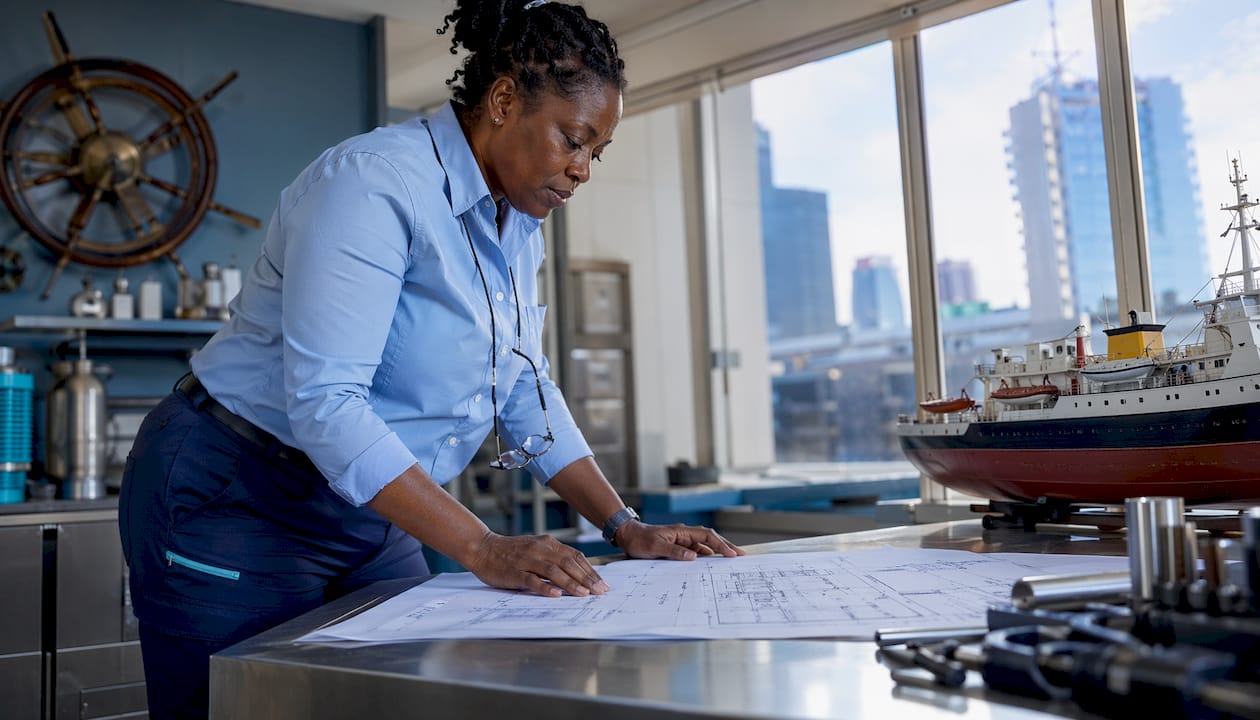
Vessel design is the systematic engineering process of converting operational requirements into a safe, efficient, and production-ready marine structure. It integrates naval architecture, structural engineering, hydrodynamics, and regulatory compliance into a single coordinated workflow. Standards from the International Maritime Organization (IMO) and classification societies such as Lloyd’s Register, DNV, and Bureau Veritas govern every stage of this process. Engineers who understand how these disciplines interact produce vessels that perform reliably, meet emissions targets, and survive the full range of operational conditions they will face at sea.
What are the main stages in the vessel design process?
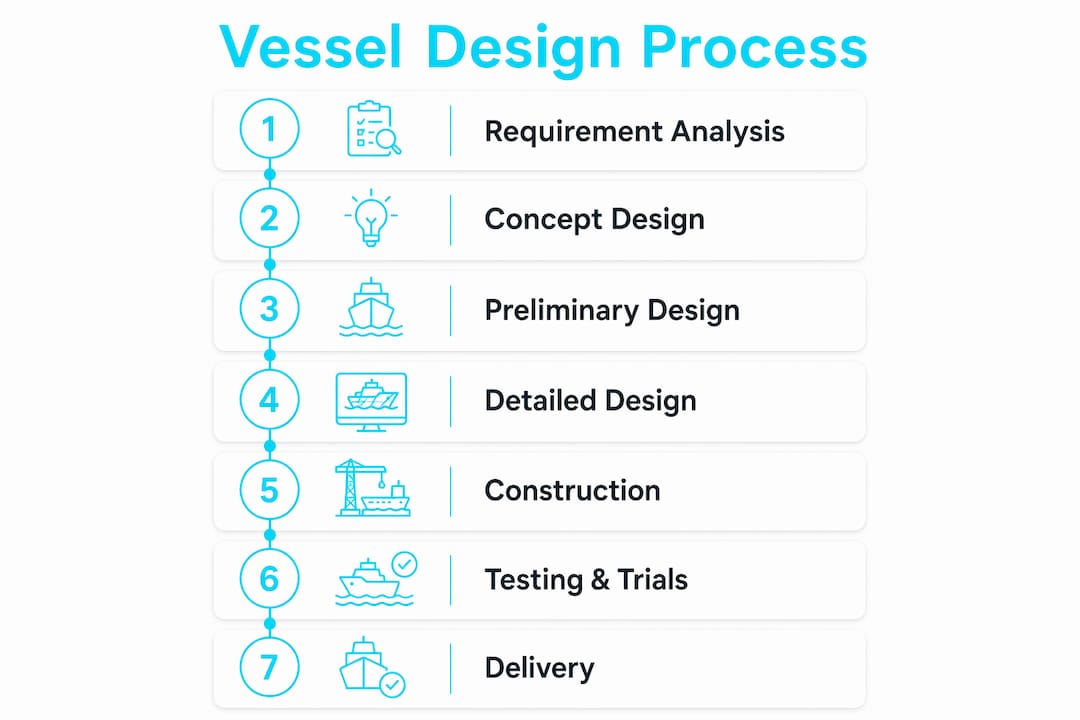
The seven-stage ship design process converts operational needs into a production-ready vessel through structured, multidisciplinary phases. Each stage builds on the previous one, and decisions made early carry significant weight on cost, schedule, and performance downstream.
Requirement analysis. Engineers define the vessel’s mission profile, payload capacity, operating routes, and regulatory constraints. This stage sets the boundaries for every decision that follows.
Concept design. The team generates multiple hull form candidates and evaluates them against the mission profile. Speed, range, stability, and cargo capacity are balanced at a high level.
Preliminary design. Key parameters are fixed: length, beam, draft, displacement, and main machinery. Classification society approval processes begin here.
Contract design. Drawings and specifications reach enough detail to support a shipbuilding contract. Owners, yards, and designers align on scope before detailed engineering begins.
Detailed design. Every system, structure, and outfitting element is fully engineered. This is the most resource-intensive phase and the one most sensitive to late-stage scope changes.
Production design. Drawings are translated into yard-specific build packages, cutting lists, and assembly sequences tailored to the shipyard’s equipment and workflow.
Construction and testing. The vessel is built, systems are commissioned, and sea trials confirm that performance meets the contracted specification.
Iterative loops between stages are normal, not a sign of failure. Concept decisions often get revisited when preliminary calculations reveal a conflict between speed targets and fuel capacity.
Pro Tip: Lock the mission profile before concept design begins. Changing the cargo type or operating route after preliminary design is complete can invalidate weeks of structural and stability work.
How does hull form design influence efficiency, safety, and compliance?
Hull form design is the single greatest lever engineers have over a vessel’s fuel consumption, seakeeping behavior, and regulatory standing. The geometry of the underwater body determines resistance, which directly drives propulsion power requirements and, by extension, operating costs and emissions.
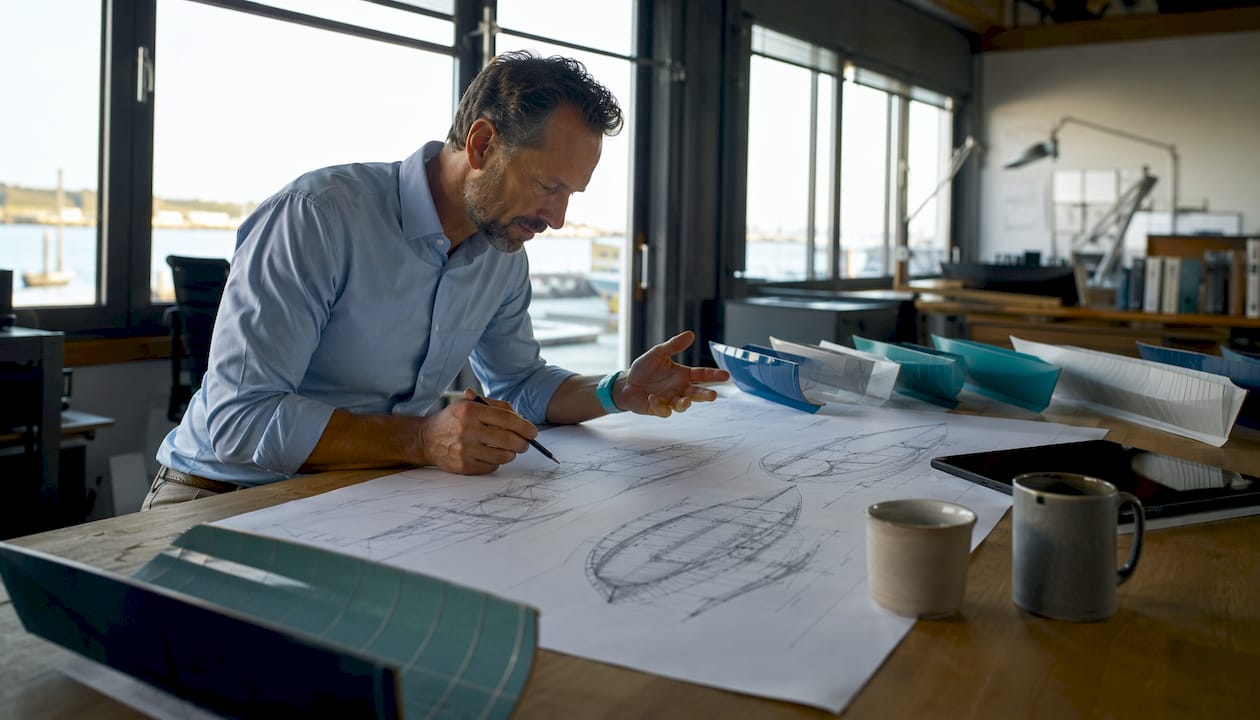
Key hull geometry parameters
Four parameters define the hull envelope and set the performance baseline:
Length between perpendiculars (LBP). Longer hulls reduce wave-making resistance at moderate speeds, improving fuel economy on long ocean routes.
Beam. Wider beams increase initial stability and cargo volume but raise frictional resistance.
Draft. Draft determines displacement and affects port access. Shallow-draft designs sacrifice some hydrodynamic efficiency for operational flexibility.
Block coefficient (Cb). Cb is the ratio of displaced volume to the bounding rectangular box. Full-form bulk carriers operate with Cb values above 0.80, while fast container ships target values closer to 0.60.
Hull type | Typical Cb range | Primary trade-off |
Bulk carrier | 0.80–0.87 | Cargo volume vs. speed |
Container ship | 0.60–0.68 | Speed vs. fuel economy |
Tanker | 0.78–0.85 | Stability vs. resistance |
Offshore supply vessel | 0.55–0.65 | Maneuverability vs. capacity |
Hull form optimization reduces fuel consumption and CO₂ emissions, helping vessels meet IMO Energy Efficiency Design Index (EEDI) regulatory thresholds. That connection between hull geometry and regulatory compliance is direct. A vessel that misses its EEDI target cannot receive an International Energy Efficiency Certificate and cannot trade internationally.
IMO energy efficiency indices depend not only on hull resistance but also on engine constraints such as derating and shaft power limits. This means hull optimization and machinery selection must happen in parallel, not sequentially. Engineers who treat them as separate workstreams routinely discover late-stage conflicts between the hull’s resistance curve and the engine’s rated output.
Pro Tip: Run computational fluid dynamics (CFD) analysis on at least three hull form variants before committing to a final geometry. CFD tools, including CFD simulation platforms, reveal resistance differences that model tests alone cannot resolve cost-effectively at the concept stage.
What modern technologies improve vessel design quality and constructability?
Digital tools have changed how engineering teams coordinate across disciplines and how they catch errors before steel is cut. The most significant shift is the move from 2D drawing sets to integrated 3D models that serve as a single source of truth for structure, outfitting, and systems.
Digital twins and 3D model-based design enable clash detection and interdisciplinary coordination, reducing costly field rework. A clash between a structural frame and a pipe run that is caught in the model costs minutes to fix. The same clash discovered during construction can cost days and significant rework expense.
Key capabilities that modern design environments deliver:
Clash detection. Automated checks identify physical interferences between structural members, piping, HVAC, and electrical runs before fabrication begins.
Multidisciplinary coordination. Structural engineers, outfitting designers, and systems engineers work within the same model, so changes propagate automatically rather than through manual drawing revisions.
Production-ready outputs. The model generates cutting lists, nesting files, and assembly drawings directly, reducing transcription errors between design and production.
Data validation and early client requirement scrutiny prevent expensive, late-stage changes in production. Engineers who accept vendor equipment data at face value without checking dimensions, weights, and connection points often discover discrepancies only when the equipment arrives at the yard.
Constructability requires early involvement of production experts to confirm that modular components fit the shipyard’s lifting, welding, and installation capabilities. A design that is technically correct but requires a crane lift beyond the yard’s capacity is not a finished design. It is a problem waiting to be discovered.
Design environments that support continuous change and multidisciplinary coordination are especially critical for one-off or highly specialized vessel designs. Standard product tankers follow well-established templates. A custom offshore research vessel or a specialized cable-laying ship requires a flexible digital environment where the design can evolve without losing coordination between disciplines.
Pro Tip: Involve the shipyard’s production team during detailed design, not after. Their knowledge of block sizes, panel line capacity, and crane reach will shape the design in ways that save weeks during construction.
How do engineers apply holistic optimization in advanced vessel design?
Standard optimization focuses on a single performance metric, usually resistance or fuel consumption, at a fixed operating condition. That approach produces vessels that perform well in the design scenario and poorly everywhere else. Holistic optimization addresses this by treating the vessel as a system operating across a range of real-world conditions.
The Robust Holistic Optimization Ship Design (RHODA) framework incorporates multiple layers of uncertainty into the design process: voyage uncertainty, environmental uncertainty, market uncertainty, and method uncertainty. Each layer represents a different source of variability that the vessel will encounter over its operating life.
Voyage simulation is the core analytical tool within RHODA. Engineers model hundreds of representative voyages, varying load conditions, weather patterns, and routing decisions. The design that performs best across this distribution, rather than at a single design point, is the one that survives volatile freight markets and changing regulatory requirements.
Holistic optimization frameworks improve vessel design resilience under decarbonization pressures and volatile market conditions. This matters because a vessel ordered today will operate for 25 or more years. Fuel prices, emissions regulations, and cargo demand will all shift over that period. A design optimized only for current conditions carries significant commercial risk.
Data archives from over 4,000 built vessels have been used by leading design firms to reduce uncertainty and improve sustainable vessel design outcomes. Historical performance data from similar vessels provides calibration points for simulation models, reducing the gap between predicted and actual performance.
The integration of decarbonization goals into holistic optimization is not optional for vessels entering service after 2030. IMO’s Carbon Intensity Indicator (CII) ratings will affect a vessel’s commercial viability throughout its life. Engineers who embed CII trajectory analysis into the design optimization process give owners a vessel that remains commercially competitive as regulations tighten.
Key Takeaways
Effective vessel design requires coordinating hull geometry, regulatory compliance, digital modeling, and holistic optimization from the earliest design stage through construction.
Point | Details |
Seven-stage design process | Each stage from requirement analysis to sea trials builds on the previous, making early decisions the most consequential. |
Hull form drives compliance | Block coefficient, length, and draft directly affect EEDI scores and fuel economy across the vessel’s operating life. |
Digital models prevent rework | 3D model-based design with clash detection catches costly interferences before fabrication begins. |
Constructability starts early | Shipyard lifting and assembly constraints must inform detailed design, not just production design. |
RHODA reduces lifecycle risk | Holistic optimization across voyage, environmental, and market uncertainties produces vessels that perform well over 25-plus years. |
Why I think most vessel design teams underestimate the cost of late coordination
The biggest source of cost overruns I see in vessel design projects is not technical complexity. It is the gap between when a decision gets made and when its consequences reach the people who have to implement it. A hull form locked in concept design without structural input creates a cascade of compromises in preliminary and detailed design. A machinery selection made without consulting the production team produces installation challenges that nobody budgeted for.
The teams that consistently deliver on schedule treat coordination as a design input, not an administrative task. They bring the shipyard into detailed design reviews. They run pressure vessel design tools and simulation software in parallel with structural work, not after it. They validate vendor data before it enters the model, not when the equipment arrives at the dock.
The other pattern I see repeatedly is over-reliance on a single operating condition for optimization. A vessel optimized for 14 knots in calm water at full load will underperform in ballast, in waves, and at the off-design speeds that make up most of its actual operating profile. Voyage simulation is not an advanced technique reserved for research projects. It is standard practice for any design team serious about lifecycle performance.
The engineers who produce the best vessels are not necessarily the ones with the most sophisticated tools. They are the ones who ask the hardest questions earliest, when changing the answer is still cheap.
— Joel
How Jewlztech supports your vessel design workflow
Engineers working through complex vessel design problems need simulation tools that integrate with their existing workflows without adding friction.
The Thermalysis Toolkit from Jewlztech provides thermal simulation, CFD analysis, and pressure vessel modeling capabilities that fit directly into the design stages where accuracy matters most. Whether you are evaluating hull resistance at the concept stage or validating system performance in detailed design, the toolkit gives you the computational depth to make confident decisions. Engineers can access free simulation tools through Jewlztech to run thermal and CFD analyses without the overhead of enterprise software licensing. Visit Jewlztech to see how the toolkit fits your current design process.
FAQ
What is vessel design in engineering?
Vessel design is the structured engineering process of converting operational requirements into a production-ready marine structure. It integrates naval architecture, structural engineering, hydrodynamics, and regulatory compliance across seven defined design stages.
What standards govern vessel design compliance?
IMO regulations, including the Energy Efficiency Design Index (EEDI) and Carbon Intensity Indicator (CII), set the primary emissions and efficiency thresholds. Classification societies such as Lloyd’s Register, DNV, and Bureau Veritas enforce structural and safety standards throughout the design and build process.
How does hull form affect fuel efficiency?
Hull geometry, particularly block coefficient and length-to-beam ratio, determines wave-making and frictional resistance. Optimized hull forms reduce fuel consumption and CO₂ emissions, directly supporting IMO EEDI compliance.
What is the RHODA framework in vessel design?
RHODA stands for Robust Holistic Optimization Ship Design Approach. It incorporates multiple uncertainty layers, including voyage, environmental, market, and method uncertainties, to produce designs that perform well across real-world operating conditions rather than only at a single design point.
Why does constructability matter in early design stages?
Shipyard lifting capacity, panel line dimensions, and welding access constraints must inform the design before detailed drawings are complete. Discovering a constructability conflict during production is far more expensive than resolving it during detailed design.
Recommended
Comments