
Convection, Conduction, and Radiation Examples for STEM


Heat transfer is defined as the movement of thermal energy between systems or within a system due to a temperature difference, occurring through three distinct mechanisms: conduction, convection, and radiation. These convection conduction and radiation examples appear everywhere, from a metal spoon warming in hot soup to the sun heating Earth across 93 million miles of vacuum. Each mechanism follows its own governing law: Fourier’s Law for conduction, Newton’s Law of Cooling for convection, and the Stefan-Boltzmann Law for radiation. Understanding which mode dominates in a given system, and by how much, separates a competent thermal engineer from one who guesses.
1. Convection conduction and radiation examples: why all three matter
Most STEM students learn these three modes in isolation. That is a mistake. Most practical systems combine conduction, convection, and radiation simultaneously, and neglecting any secondary mode reduces simulation accuracy. A hot pipe loses heat through conduction into its supports, convection to the surrounding air, and radiation to the environment, all at the same time. Recognizing which mode dominates at a given temperature range or geometry is the first skill a thermal engineer develops.
Radiation deserves special attention here. Doubling the absolute temperature of a surface increases radiative output 16-fold due to the T⁴ dependence in the Stefan-Boltzmann Law. That nonlinear scaling means radiation often overtakes convection at elevated temperatures, even when a fluid is present. Engineers who default to convection-only models in high-temperature systems consistently underpredict heat loss.
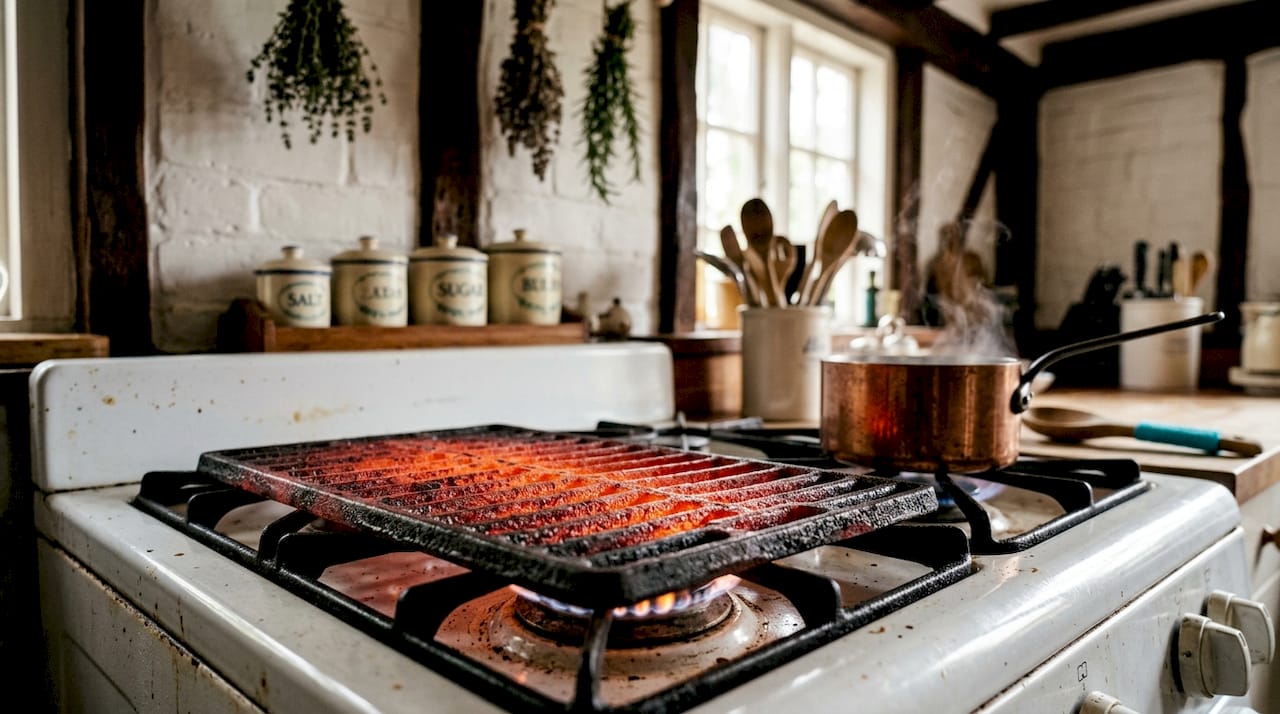
2. Metal pan on a stovetop: the clearest conduction case
Conduction is heat transfer through direct molecular contact, with no bulk movement of matter. A cast iron pan sitting on a gas burner is the textbook example. Heat flows from the burner flame through the pan’s base by lattice vibration and free electron movement, reaching the cooking surface in seconds.
The rate of that transfer follows Fourier’s Law: heat flux equals thermal conductivity multiplied by the temperature gradient. Copper has a thermal conductivity near 400 W/m·K. Stainless steel sits around 15 W/m·K. That 26-fold difference explains why copper-bottomed pans heat faster and more evenly than all-steel alternatives.
Cast iron pan: High thermal mass, slow to heat, excellent heat retention for searing
Aluminum pan: Thermal conductivity near 205 W/m·K, fast and even heat distribution
Wooden handle: Low conductivity, acts as a thermal break to protect your hand
Pro Tip: When modeling conduction in a composite wall, treat each material layer as a thermal resistance in series. The total resistance equals the sum of each layer’s thickness divided by its conductivity times area.
3. Building walls and insulation: conduction at the structural scale
Heat transfer through a building envelope is pure conduction in steady state. The R-value system used in American construction directly quantifies thermal resistance: higher R-values mean lower conductive heat loss per unit area. Fiberglass batt insulation achieves R-3.7 per inch, while closed-cell spray foam reaches R-6.5 per inch. That difference drives significant energy cost variation across a building’s lifetime.
Engineers model multi-layer walls, including drywall, insulation, sheathing, and cladding, as a series of thermal resistances. The weakest link in that chain, often a metal stud bridging the insulation layer, can reduce the effective R-value of a wall assembly by 30% or more. This is called thermal bridging, and it is a primary target in high-performance building design.
4. Boiling water and steam: convection at its most efficient
Convection transfers heat through bulk fluid movement, either driven by buoyancy (natural convection) or an external force like a fan or pump (forced convection). Boiling water is the most efficient common convection scenario. Boiling water heat transfer coefficients range from 2,500 to 10,000 W/m²·K. Compare that to natural convection in a baking oven at just 5–25 W/m²·K, and the performance gap becomes obvious.
That gap explains why blanching vegetables in boiling water takes two minutes while roasting in an oven takes forty. The mechanism is the same, fluid carrying heat to the food surface, but the coefficient differs by three orders of magnitude. Phase change convection, where steam condenses on a cooler surface, pushes performance even further. Condensing steam transfers heat at rates up to 4,000 times faster than still air at the same temperature difference.
5. Forced convection in electronics cooling
Forced convection is the dominant heat transfer method in electronics thermal management. A CPU cooler with a fan drives air across aluminum fins, achieving forced convection coefficients in air from 25 to over 500 W/m²·K depending on airflow velocity and fin geometry. Natural convection in the same geometry without a fan would deliver roughly 5–25 W/m²·K. That is why passive cooling fails above a certain power density threshold.
Fan-cooled CPU heatsink: Forced airflow across aluminum fins removes heat from the die
Liquid-cooled server rack: Water’s higher heat capacity and conductivity outperforms air cooling at high power densities
Automotive radiator: Forced airflow from vehicle motion and a mechanical fan cools engine coolant
HVAC air handler: A blower forces conditioned air through ducts, transferring heat to or from occupied spaces
Wind tunnel testing: Controlled forced convection allows precise measurement of aerodynamic heat loads
Pro Tip: For a quick estimate in early-stage design, use h = 10 W/m²·K for natural convection in air and h = 100 W/m²·K for moderate forced convection. These numbers are conservative but prevent undersizing.
6. The sun heating Earth: radiation across a vacuum
Radiation is heat transfer via electromagnetic waves and requires no medium. The sun delivers roughly 1,361 W/m² to the top of Earth’s atmosphere through 150 million kilometers of vacuum. No conduction or convection is possible across that gap. This is the defining characteristic of radiation: it works where the other two modes cannot.
Every object above absolute zero emits thermal radiation. Human skin emissivity is approximately 0.98, meaning it radiates close to a perfect blackbody. At room temperature, a person radiates roughly 100 W continuously. That is why a crowded room feels warm even before the HVAC system responds.
Solar irradiance: Electromagnetic energy from the sun heating Earth’s surface and oceans
Incandescent light bulb: Only about 5% of input energy becomes visible light; the rest radiates as infrared heat
Infrared heater: Directly heats objects and people without warming the intervening air
Thermos flask: Silvered inner walls minimize radiative heat transfer between the hot liquid and the outer shell
7. Grilling and broiling: radiation in the kitchen
Grilling uses infrared radiation as its primary heat transfer mode. Grill grates reach surface temperatures between 260 and 370°C during grilling, and the radiant energy from those hot surfaces cooks the food surface directly. The characteristic sear marks and Maillard reaction products on grilled meat come from this direct radiative and conductive contact, not from convection of hot air.
Broiling in an oven works the same way. The top heating element glows red and emits intense infrared radiation downward onto the food surface. Air temperature in the oven matters far less than the element’s surface temperature and its proximity to the food. This is why broiling browns a surface in two minutes while baking at the same air temperature takes twenty.
Emissivity controls how efficiently a surface radiates. A matte black cast iron grill grate has emissivity near 0.95 and radiates aggressively. A polished stainless steel surface has emissivity near 0.15 and radiates far less at the same temperature. Thermal emissivity critically influences radiative heat transfer efficiency, which is why surface finish is a design variable in thermal systems, not just an aesthetic choice.
8. Combined heat transfer: the oven as a system
An oven demonstrates all three heat transfer modes acting simultaneously. The heating element radiates infrared energy to the food and oven walls. Hot air circulates by natural convection (or forced convection in a convection oven) and transfers heat to the food surface. The food’s outer layer conducts heat inward to cook the interior.
Pan frying uses conduction as the dominant mode, with oil convection coefficients between 250 and 1,000 W/m²·K at the pan-food interface. Switching to a convection oven setting adds a fan, raising the air-side coefficient from the natural convection range of 5–25 W/m²·K to the forced convection range. The result is faster, more even cooking. Engineers model these combined modes using finite element analysis or CFD to predict temperature distributions accurately.
Recognizing combined modes matters in industrial systems too. A hot pipe in a process plant loses heat through all three paths simultaneously. Insulation reduces conduction. Lagging reduces convection. Low-emissivity coatings reduce radiation. Optimizing all three together produces the best result. Focusing on only one mode while ignoring the others leaves performance on the table.
Key takeaways
Conduction, convection, and radiation each follow distinct governing laws, but real systems always combine all three modes, and accurate thermal analysis requires modeling each one.
Point | Details |
Governing laws differ by mode | Fourier’s Law, Newton’s Law of Cooling, and the Stefan-Boltzmann Law each describe a distinct heat transfer mechanism. |
Radiation scales with T⁴ | Doubling absolute temperature increases radiative output 16-fold, making radiation dominant at high temperatures. |
Forced convection outperforms natural | Forced convection in air achieves 25–500 W/m²·K versus 5–25 W/m²·K for natural convection in the same geometry. |
Real systems combine all three modes | A hot pipe loses heat through conduction, convection, and radiation simultaneously; neglecting any mode reduces accuracy. |
Emissivity controls radiative performance | Surface finish is a design variable: high-emissivity surfaces radiate aggressively, low-emissivity surfaces retain heat. |
What I’ve learned from watching engineers get heat transfer wrong
The most common mistake I see from STEM students and early-career engineers is treating heat transfer modes as mutually exclusive. They calculate convection, declare the problem solved, and miss the radiation component entirely. At temperatures above 300°C, that omission produces errors large enough to fail a design.
The second mistake is confusing natural and forced convection. Distinguishing natural from forced convection is not academic. It determines whether a passive heatsink will keep a chip below its junction temperature or whether you need a fan. Getting that call wrong means either an overdesigned, expensive system or a field failure.
My advice: start every thermal problem by sketching all three modes and estimating their relative magnitudes. Use the governing laws as order-of-magnitude checks before running any simulation. The heat exchange fundamentals are not complicated, but they require deliberate attention. If you skip that step, your simulation gives you a precise answer to the wrong question.
The engineers who get this right are not smarter. They are more systematic. They treat the three modes as a checklist, not a menu.
— Joel
Jewlztech’s thermal analysis tools for STEM professionals
Thermal analysis that accounts for conduction, convection, and radiation simultaneously requires more than hand calculations. Jewlztech builds engineering software specifically for this problem.

The Thermalysis Toolkit lets you model all three heat transfer modes in a single simulation environment, with support for CFD analysis, thermal simulation, and pressure vessel design. Students get access to free engineering tools that apply the same governing laws covered in this article to real geometry and real boundary conditions. If you are working through heat transfer coursework or designing a thermal system professionally, the Thermalysis Toolkit gives you a direct path from theory to verified results. Visit the Jewlztech blog for worked examples and application guides that extend what you have read here.
FAQ
What is the difference between conduction, convection, and radiation?
Conduction transfers heat through direct molecular contact in solids. Convection transfers heat through bulk fluid movement. Radiation transfers heat via electromagnetic waves and requires no physical medium.
Which heat transfer mode is fastest?
Phase-change convection, specifically condensing steam, achieves the highest heat transfer coefficients, reaching 5,000–100,000 W/m²·K. Radiation becomes dominant at very high temperatures due to its T⁴ dependence.
Can radiation transfer heat through a vacuum?
Radiation is the only heat transfer mode that works through a vacuum. Conduction and convection both require a physical medium, which is why the sun heats Earth entirely through radiation across empty space.
What are real-life examples of conduction?
A metal spoon warming in hot soup, heat flowing through a building wall, and a cast iron pan heating on a stovetop are all real-life examples of conduction driven by direct molecular contact.
Why does a convection oven cook faster than a standard oven?
A convection oven uses a fan to force air circulation, raising the heat transfer coefficient from the natural convection range of 5–25 W/m²·K to the forced convection range. That higher coefficient delivers more heat to the food surface per unit time.
Recommended
Comments